description: AWS reference architectures for landing your isp6 IPv6 PA assignment in production: a multi-AZ single-Region pattern with VPC IPAM, Application Load Balancer, and Egress-only In
Reference Architectures: AWS
Audience: isp6 members and AWS architects who have completed (or are about to complete) the AWS BYOIP onboarding and want a production-grade topology to land their /48 or /44 on. This article assumes the sizing decision from Sizing: /44 vs /48 has been made.
Last updated: May 2026
1. What's in this article
Two AWS reference architectures, both built around a real isp6 BYOIP /48 or /44:
- Architecture A: a single-Region production deployment for one workload. Two Availability Zones, three subnet tiers (public / application / data), Application Load Balancer, Internet Gateway and Egress-only Internet Gateway, RDS Multi-AZ. Right-sized for a single product team in one Region.
- Architecture B: a multi-Region, multi-account deployment. VPC IPAM in a network account holds the top-level /44; regional /48 pools are RAM-shared into workload accounts; each Region runs a Transit Gateway with an inspection VPC and spoke workload VPCs; Regions are connected by TGW peering.
Each architecture is the IPv6 / BYOIP plane of the design only. The rest of the Well-Architected Framework (identity, observability, FinOps, resilience patterns beyond multi-AZ / multi-Region) is unchanged by IPv6 and is out of scope here.
For BYOIP mechanics (ROAs, ownership verification, provision-byoip-cidr,
advertise-byoip-cidr, AWS account limits) read Bring Your Own IPv6 to AWS.
2. Architecture A: single-Region production
When to choose this: one Region serves your traffic, one workload (or a small set of related workloads), one AWS account, and you've decided that the blast radius of a regional outage is acceptable or covered by application-layer resilience elsewhere.
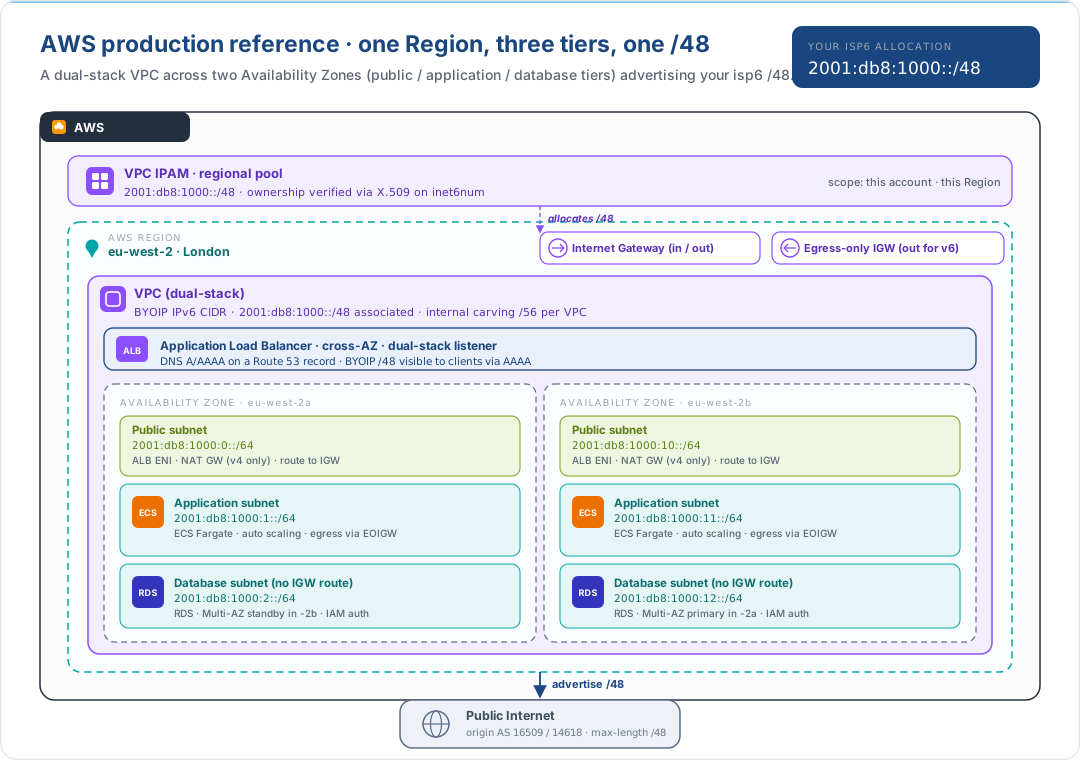
2.1 What each component carries
| Component | IPv6 role | Notes |
|---|---|---|
| VPC IPAM (regional pool) | Holds the BYOIP /48 with ownership verified once, then hands the entire /48 to the VPC. Even at single-Region scale, IPAM gives you an audit trail and a recovery story | Optional at this size; provision-byoip-cidr directly is also viable. See BYOIP guide §5 |
| VPC (dual-stack) | The BYOIP /48 is associated as a secondary CIDR alongside the IPv4 CIDR. Internal carving uses /56 per VPC for consistency with multi-VPC futures | Dual-stack throughout, with IPv4 staying for non-IPv6-capable services (e.g. some endpoints, some legacy clients) |
| Public subnet (/64 per AZ) | Hosts the ALB ENIs and any NAT Gateway for IPv4. Route table has ::/0 → IGW |
Green family in the diagram |
| Application subnet (/64 per AZ) | Hosts ECS Fargate tasks (or EC2). Route table has ::/0 → EOIGW so tasks can reach the internet outbound only |
Teal family |
| Database subnet (/64 per AZ) | Hosts the RDS instances. No default IPv6 route; explicit deny on ::/0 keeps the data tier off the internet entirely |
Teal family, the same security colo |
| Application Load Balancer | Dual-stack listener, so clients hit it on either family; backend pool is reached on IPv6 inside the VPC | A Route 53 record with both an A and an AAAA pointing |
| Internet Gateway | Inbound and outbound for IPv4 and IPv6 in the public tier | One per VPC |
| Egress-only Internet Gateway | IPv6 outbound-only for private tiers | Replaces NAT Gateway for IPv6, with no per-GB processing fee and no per-hour gateway fee. NAT Gateway is still needed for I |
2.2 IPv6 addressing inside the /48
A /48 gives you 65,536 /64 subnets, more than enough. A pragmatic convention
that works at every scale:
/48 → /56 (per VPC)    e.g. 2001:db8:1000::/56
       /64 (per subnet) e.g. 2001:db8:1000:0::/64   AZ-a · public
                             2001:db8:1000:1::/64   AZ-a · app
                             2001:db8:1000:2::/64   AZ-a · data
                             2001:db8:1000:10::/64  AZ-b · public
                             2001:db8:1000:11::/64  AZ-b · app
                             2001:db8:1000:12::/64  AZ-b · data
The low nibble of the third hextet identifies the AZ; the next nibble identifies the tier. The same convention scales unchanged into the multi-Region case below, where each Region gets its own /48 and the same /56 / /64 carving repeats within. For the deeper internal carving discussion, see Planning Your isp6 Allocation.
2.3 What changes from "two-AZ /48" in the sizing article
This is the production version of the sizing-article example. The two extensions that matter:
- A dedicated data tier. The sizing article showed public + private; production almost always separates data into its own subnet, with no route to the IGW or EOIGW. RDS sits there.
- The ALB spans AZs. A single dual-stack ALB with subnets in both AZs is the default fronting pattern: clients see one DNS name and one AAAA record, and AZ failover is handled transparently.
3. Architecture B: multi-Region with VPC IPAM and Transit Gateway
When to choose this: two or more Regions serve your traffic, you have an AWS Organization with a dedicated network account, and you want centralised egress inspection (a firewall in front of every workload VPC's IPv6 egress).
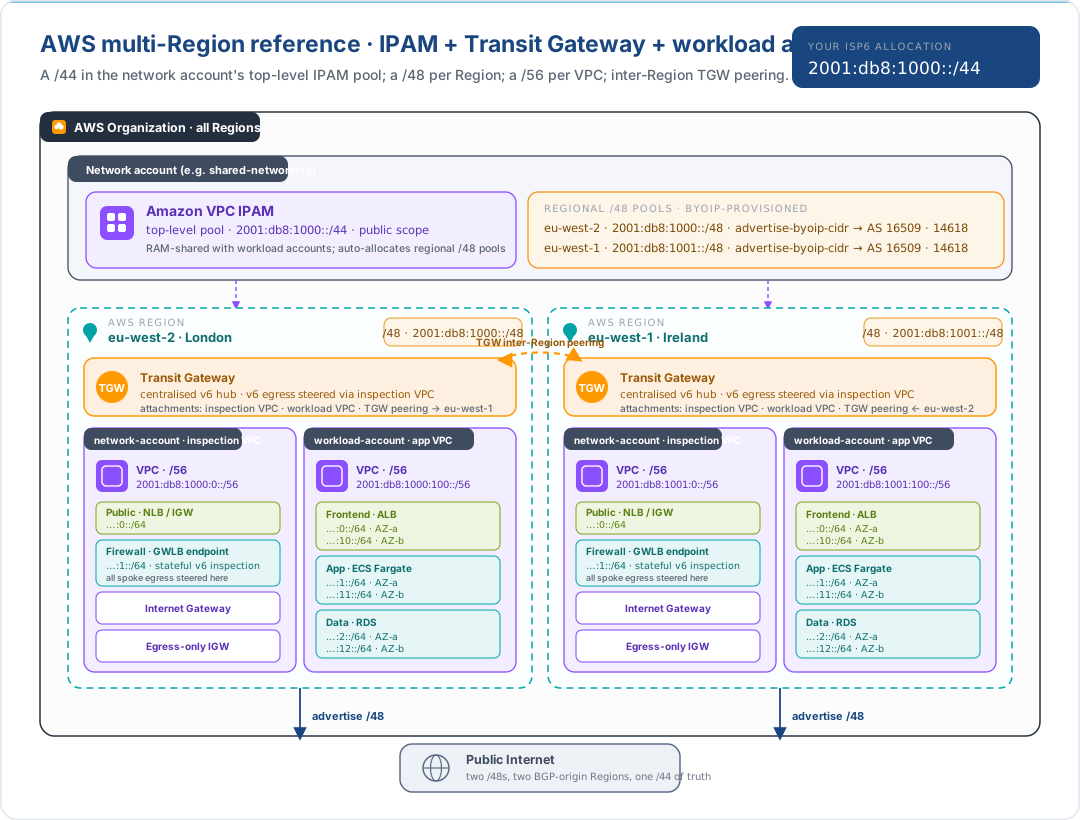
3.1 The IPAM hierarchy
| Level | Block | Where it lives | Who can draw from it |
|---|---|---|---|
| Top-level pool | /44 |
Network account, Public scope |
All in-Organization accounts via RAM share |
| Regional pool (per Region) | /48 |
Network account, locked to a Region | Workload accounts targeting that Region |
| VPC allocation | /56 |
Workload account, attached to a VPC | The VPC itself; subnets carve /64s out of it |
The point of the hierarchy is that the /48 is the unit advertised to the public internet (why) and the unit owned by a single Region, so there is a 1:1 correspondence. Carving deeper than /48 (into /56 per VPC) is purely an internal concern: it gives every workload account a clean, non-overlapping slice and leaves room to grow inside each Region without a renumber.
3.2 Per-Region anatomy
Every Region in the diagram repeats the same shape:
- A Transit Gateway in the network account, attached to every VPC in that Region. It's the IPv6 hub-and-spoke fabric for inter-VPC traffic, inter-account traffic, and (importantly) all egress to the internet pass through the TGW before reaching an IGW or EOIGW in the inspection VPC.
- An inspection VPC in the network account, holding the IGW, the EOIGW, and a
Gateway Load Balancer in front of a stateful firewall fleet. Spoke VPCs route
::/0to the TGW; the TGW routes to the inspection VPC; the inspection VPC routes through the firewall and out via the IGW or EOIGW. - One (or more) workload VPCs in workload accounts, each with the three-tier layout from Architecture A, drawing its /56 from the regional /48 pool.
3.3 Inter-Region paths
Inter-Region traffic uses Transit Gateway peering. The eu-west-2 TGW and the us-east-1 TGW peer over the AWS backbone, and route tables on each side carry the peer Region's VPC /56 prefixes. This keeps east-west traffic off the public internet, but it does not change the fact that each Region's /48 is advertised separately, from its own BGP origin, to the public internet. There is no anycast across Regions on AWS; clients see one of the two Regions per session, and either DNS-based geo-routing (Route 53 latency-based or geolocation routing) or AWS Global Accelerator picks which one.
3.4 Why each Region has its own /48
This is the same constraint from the sizing article repeated in the production
context: AWS BYOIP is per-Region, and the /48 is the longest globally-routable
prefix. The same /48 cannot be provision-byoip-cidr'd in two Regions
simultaneously. Each Region needs a distinct /48 from the same /44, advertised
from that Region's edge. See Sizing §5.
4. AWS-specific design rules
A short list of AWS-specific gotchas that shape these architectures and that don't apply on Azure or GCP:
- IPv6 secondary CIDR on a VPC is immutable. Once you associate the BYOIP /48 with a VPC, you cannot disassociate it without recreating the VPC. Plan the VPC shape before associating.
- Subnet IPv6 CIDR is also immutable. Use the /56-per-VPC convention so you always have headroom inside a VPC to add subnets without re-architecting.
- EOIGW is IPv6-only. It does not carry IPv4 traffic; IPv4 egress for private subnets still goes through NAT Gateway. Don't be surprised when removing NAT Gateway breaks something IPv4-shaped.
- Security Groups need explicit IPv6 rules. A rule on
0.0.0.0/0does not cover::/0. Audit every Security Group when you turn on IPv6. - RPKI ROAs must list
16509and14618. The second ASN is AWS Global Accelerator, and getting it wrong means the advertisement holds but Global Accelerator can't use the prefix. See BYOIP §8.2. - Account limit: five BYOIP CIDRs per Region per account (combined IPv4 + IPv6). For Architecture B, the /48 lives in the network account, so workload accounts don't burn against the limit.
5. What's intentionally out of scope
The diagrams above are deliberately bounded to the IPv6 / BYOIP plane. The following are deferred to other sources:
| Topic | Where to read |
|---|---|
| BYOIP onboarding, costs, lifecycle | Bring Your Own IPv6 to AWS |
| Sizing decision (/48 vs /44) | Sizing: /44 vs /48 |
| Internal /48 carving (bit-budget method) | Planning Your isp6 Allocation |
| Identity, IAM, AWS Organizations design | AWS Well-Architected Framework |
| Resilience beyond multi-AZ / multi-Region | AWS Resilience Hub guidance |
| Observability, FinOps, security baselines | Cloud Adoption Framework / Well-Architected pillars |
The IPv6 layer slots underneath all of them without changing their conclusions, which is the point.
6. Further reading
Other reference architectures in this series
- Reference Architectures: An Overview: start here for the cross-provider terminology and the deployment-mode decision aid
- Reference Architectures: Azure
- Reference Architectures: Google Cloud
- Reference Architectures: On-Premises and Colocation
isp6 knowledge base
- Bring Your Own IPv6 to AWS: BYOIP mechanics, ownership verification, ROAs, costs
- Sizing: /44 vs /48: which size to order
- Planning Your isp6 Allocation: internal carving
AWS documentation
- Amazon VPC IP Address Manager (IPAM)
- IPv6 on AWS
- VPC IPv6 support: Amazon VPC User Guide
- Transit Gateway and IPv6
- Egress-only internet gateway
- AWS Well-Architected Framework
IETF
- RFC 6177: IPv6 Address Assignment to End Sites
- RFC 7454: BGP Operations and Security
- RFC 3849: IPv6 Address Prefix Reserved for Documentation
7. BYOIP rollout: quick checklist
If your VPC association is failing, your prefix isn't routable, or describe-ipv6-pools returns empty, walk through this in order. Each step gates the next: if step 2 didn't succeed, step
The commands below use the
2001:db8::/48documentation prefix (RFC 3849) andeu-west-1as the Region. Substitute your real isp6/48and target Region. AWS BYOIP CLI behaviour, return codes, and state-machine transitions are defined by AWS and may change, so treat the AWS references listed at the end of this section as authoritative.
Step 1: generate the signed authorisation in the isp6 console
In the subnet dashboard for the /48 you're bringing to AWS, the cloud panel produces two strings using the private key from your onboarding step 9:
text_message: the AWS-format authorisation context plain textsigned_message: the RSA signature overtext_message
Both are required by provision-byoip-cidr. Re-generating is idempotent and safe, so produce fresh values whenever an older signature is rejected (signatures expire).
Step 2: provision the CIDR into AWS
aws ec2 provision-byoip-cidr \
  --cidr 2001:db8::/48 \
  --cidr-authorization-context Message="$text_message",Signature="$signed_message" \
  --region eu-west-1
This kicks off AWS's ownership verification (ROA + signature). Verification can take hours to days. The CIDR transitions through pending-provision → provisioned. Until it reaches provisioned, advertise-byoip-cidr will fail.
Step 3: flip the CIDR to advertised
aws ec2 advertise-byoip-cidr --cidr 2001:db8::/48 --region eu-west-1
This is the BGP-advertisement switch. Until it runs, traffic destined for your prefix won't reach AWS, even if the VPC association succeeds. State transitions provisioned → advertised. Reversible via withdraw-byoip-cidr.
Step 4: verify with the describe calls
aws ec2 describe-byoip-cidrs --max-results 10 --region eu-west-1
aws ec2 describe-ipv6-pools --region eu-west-1
Expected output on a healthy rollout:
describe-byoip-cidrsreturns your/48with"State": "advertised". Anything else (pending-provision,provisioned,failed-provision,pending-advertise,failed-advertise,pending-withdraw) means a step is incomplete or AWS hasn't finished a verification.describe-ipv6-poolsreturns oneIpv6Poolper BYOIP CIDR in the account/Region, each with aPoolIdof the formipv6pool-ec2-…. ThisPoolIdis the value you pass when associating the CIDR with a VPC (ipv6_poolonaws_vpc_ipv6_cidr_block_associationin Terraform,--ipv6-poolonaws ec2 associate-vpc-cidr-block). Without it, AWS rejects the association.
Common failure modes
| Symptom | Likely cause |
|---|---|
provision-byoip-cidr returns InvalidSignature |
Stale or mis-copied signed_message. Re-generate in the isp6 console and retry. |
Stuck in pending-provision for >24h |
AWS-side verification queue is slow, or your ROA doesn't list ASN 16509 for the target Region's edge. See BYOIP §8.2. |
advertise-byoip-cidr returns IncorrectState |
CIDR is still pending-provision. Wait for provisioned before advertising. |
| Prefix not reachable from the public internet | advertise-byoip-cidr not yet run, or the VPC has no public IPv6 path (no IGW, missing ::/0 route on the subnet route table). |
Terraform VPC association fails with Ipv6Pool is required |
byoip_ipv6_pool_id not set. Look it up via describe-ipv6-pools in the owning account and wire it into your tfvars. |
Authoritative references
AWS owns this lifecycle end-to-end. If anything in this checklist disagrees with AWS's documentation, AWS wins:
- Bring your own IP addresses (BYOIP) in Amazon EC2
- BYOIP for Amazon VPC
provision-byoip-cidr: AWS CLI Referenceadvertise-byoip-cidr: AWS CLI Referencedescribe-byoip-cidrs: AWS CLI Referencedescribe-ipv6-pools: AWS CLI Reference
This document is provided for informational purposes. Protocol specifications and cloud provider behaviour are subject to change. Consult the linked RFCs and vendor documentation for authoritative, up-to-date information before making architectural decisions.