Bring Your Own IPv6 to AWS: A Guide for isp6 Members
Audience: isp6 members, cloud architects, and network engineers bringing their isp6-allocated IPv6 PA space to AWS using BYOIP.
Last updated: April 2026
1. Introduction
As an isp6 member, you already own a portable IPv6 allocation: a /48 or /44 block of Provider Aggregatable (PA) address space, registered in the RIPE Database and managed through your isp6 subnet dashboard. This guide walks you through how to bring that allocation to AWS using BYOIP (Bring Your Own IP), so you can use your own addresses across your cloud infrastructure while retaining full portability.
isp6 is a Local Internet Registry (LIR) and RIPE NCC member. Your assignment is drawn from isp6's RIPE NCC allocation and is yours to announce from any network, whether AWS, another cloud provider, a colocation facility, or all three simultaneously. BYOIP on AWS is one of the most common use cases for isp6 members, and this guide covers everything you need to make it work.
2. Why Bring Your isp6 Allocation to AWS
2.1 Cost Elimination, Not Just Cost Reduction
AWS's public IPv4 pricing change (effective February 2024) charges $0.005/hour per public IPv4 address, attached or idle. A modest estate of 500 public IPv4 addresses costs roughly $21,900/year before a single byte of data leaves the VPC.
IPv6 changes the equation entirely: AWS does not charge for public IPv6 addresses, whether AWS-assigned or BYOIP. Combined with the Egress-Only Internet Gateway (no hourly or per-GB processing fee, unlike NAT Gateway's $0.045/GB), IPv6 removes two entire line items from your networking bill.
2.2 A Clean Reputation Slate
Your isp6 allocation is a fresh, never-before-used block from isp6's RIPE NCC address pool. There is no prior owner, no inherited blocklist entries, no "noisy neighbour" effect. When you bring this allocation to AWS via BYOIP, you start with a pristine reputation, which is ideal for outbound email, API integrations, and any service where IP reputation affects deliverability or trust scoring.
Note: While your allocation starts clean, you are responsible for maintaining that reputation post-deployment. Misconfigured mail servers or abusive traffic originating from your range will degrade it over time.
2.3 True Portability
Because your allocation is registered through isp6's LIR under RIPE NCC, you can withdraw it from AWS and re-advertise it from another provider, a colocation facility, or a different cloud, all without changing a single allowlist entry or DNS record on the consumer side. Your addresses are never locked to a single cloud provider.
2.4 Address Planning at Scale
A /48 allocation gives you 65,536 /64 subnets, each containing a practically unlimited number of host addresses. A /44 gives you 16 times that. This removes subnet exhaustion as a design constraint and simplifies VPC CIDR planning across multi-account, multi-region architectures.
3. What isp6 Handles vs. What You Do on AWS
One of the advantages of ordering your IPv6 space through isp6's self-service portal is that many of the traditionally complex steps in the BYOIP process are already taken care of. Here is a clear breakdown.
isp6 handles
| Task | Detail |
|---|---|
| PA assignment | Your /48 or /44 is assigned from isp6's RIPE NCC allocation and registered in the RIPE Database |
| inet6num registration | The RIPE DB inet6num object is created automatically when your order is fulfilled |
| RPKI and ROA management | ROAs are created and managed through isp6's RPKI management, including ROAs for cloud provider ASNs needed for BYOIP (see Section 8.2). isp6 monitors ROA propagation status so you can track readiness from your dashboard |
| route6 objects | BGP route objects are created in the RIPE Database as part of your subnet activation |
| Reverse DNS | Configurable through your isp6 subnet dashboard (nameservers and DNSSEC DS records) |
| RSA key pair and RIPE NCC certificate | During onboarding, isp6 generates an RSA 2048-bit key pair in your browser via Web Crypto. The public key is registered on the RIPE NCC inet6num object automatically. You retain the private key for signing cloud provider authorisation messages (see Section 8.3) |
| Ongoing RIPE NCC compliance | isp6 maintains the LIR relationship with RIPE NCC and keeps your registration current |
You handle on the AWS side
| Task | Detail |
|---|---|
| Signed authorisation message | Use the private key from your isp6 onboarding to create the signed message AWS requires for BYOIP provisioning. If using IPAM, a DNS TXT record is an alternative (see Section 8.3) |
| AWS BYOIP provisioning | Provision, advertise, and associate your CIDR within your AWS account |
| VPC and resource configuration | Associate the BYOIP CIDR with your VPC and assign addresses to resources |
Key point: You do not need to apply to RIPE NCC, justify address need, or navigate RIR processes. Your isp6 membership and order give you a registered, RPKI-ready allocation that is ready for BYOIP from day one.
4. How isp6 Manages the Lifecycle of Your Allocation
When you bring your isp6 allocation to AWS, isp6 continues to manage the full RIPE NCC lifecycle in the background. Understanding this lifecycle helps you see where AWS BYOIP fits within the broader picture.
4.1 Lifecycle Overview
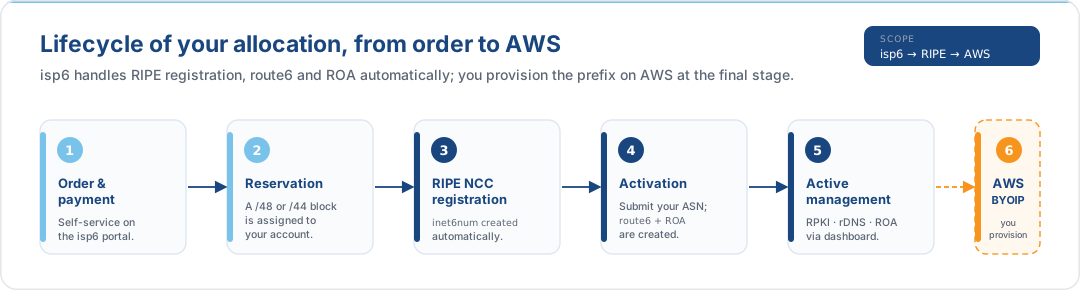
4.2 What Happens at Each Stage
| Stage | Who | What happens |
|---|---|---|
| Order & payment | You (via isp6 portal) | Select /48 or /44, complete identity verification, pay |
| Reservation | isp6 (automatic) | A block from the isp6 pool is reserved and linked to your account |
| RIPE NCC registration | isp6 (automatic) | An inet6num object is created in the RIPE Database for your block |
| Activation | You (via isp6 dashboard) | You submit your origin ASN. isp6 creates the route6 object and publishes a ROA via RPKI |
| Active management | You + isp6 | You request configuration changes (ASN, maximal length, reverse DNS) through the isp6 dashboard. isp6 executes the RIPE NCC API operations |
| AWS BYOIP | You (on AWS) | You add the AWS ASNs via the cloud panel in the isp6 dashboard, verify ownership, and provision the BYOIP CIDR in AWS |
| Ongoing | isp6 | isp6 maintains RIPE NCC compliance, monitors registration state, and handles membership renewals |
| Deprovisioning | isp6 (if membership expires) | If your membership lapses, isp6 deprovisions the RIPE NCC objects in the correct order (ROA, route6, domain, inet6num) |
4.3 How This Relates to AWS
Your AWS BYOIP CIDR operates alongside isp6's RIPE NCC lifecycle management, not instead of it. Specifically:
- ROAs: isp6 manages all ROAs for your allocation. Your network ASN and the AWS
ASNs (
16509,14618) are both published through isp6's RIPE NCC certification authority. - route6 objects: isp6 manages the RIPE DB
route6for your origin ASN. AWS separately updates RADb when you advertise your BYOIP CIDR (you do not need to manage RADb entries). - Reverse DNS: configured through your isp6 dashboard. AWS does not manage reverse DNS for BYOIP prefixes; the delegation configured in RIPE NCC via isp6 is authoritative.
- Deprovisioning: if you deprovision from AWS, your isp6 allocation and all RIPE NCC registrations remain intact. If your isp6 membership expires, the RIPE NCC objects are cleaned up by isp6, so you should deprovision from AWS before that happens.
Important: Keep your isp6 membership active for as long as you are using the allocation on AWS. If the membership lapses, isp6 will deprovision the RIPE NCC objects, which will invalidate the ROA and cause AWS to stop advertising your prefix.
5. Solution Options: IPAM vs. Manual EC2 Provisioning
There are two primary ways to onboard your IPv6 space into AWS. Choosing the right one depends on your organisational scale and operational maturity.
| Feature | AWS VPC IPAM (Managed) | Direct EC2 CLI (Manual) |
|---|---|---|
| Primary tool | Amazon VPC IP Address Manager | aws ec2 provision-byoip-cidr |
| Verification method | X.509 certificate (RDAP) or DNS TXT record | X.509 certificate (RDAP) only |
| Management | Centralised dashboard for multi-account, multi-region | Per-account, per-region, and must be repeated in each |
| Automation | Manages the CIDR lifecycle; integrates with AWS Organizations | Manual scripting required for tracking and allocation |
| Complexity | Higher initial setup; lower long-term overhead | Simple for a single /48 in one account |
| Visibility | Historical audit trails, compliance monitoring, IPAM policies | Manual tracking (spreadsheets, custom tooling) |
| IPv6 prefix sizes | /48 (publicly advertisable), /60 (non-public) | /48 (publicly advertisable), /52 (non-public) |
| Service integrations | CloudFront Anycast Static IPs, EC2, VPC | EC2, VPC |
When to choose IPAM: You manage more than two accounts, operate in multiple regions, or need to integrate BYOIP with CloudFront Anycast Static IPs.
When CLI is sufficient: You are onboarding a single /48 in one account and one region, and your team is comfortable with CLI-based lifecycle management.
For full IPAM onboarding steps, see Bring your own IPv6 CIDR to IPAM.
isp6 /44 allocations and AWS BYOIP: AWS requires a minimum /48 for publicly advertisable BYOIP. If you hold a /44 from isp6, you can bring the entire /44 as a single BYOIP CIDR (AWS accepts any prefix up to /48 in length), or you can bring individual /48s carved from it, for example one /48 per AWS account or region.
6. Cost Implications
6.1 Comparative Cost Model
The table below compares the annualised cost of three addressing strategies. All pricing is indicative, so verify current rates at AWS VPC Pricing and IPAM Pricing.
| Cost Component | AWS-Assigned IPv4 | BYOIP IPv4 | BYOIP IPv6 (isp6) |
|---|---|---|---|
| Public IP hourly charge (256 IPs) | ~$11,200/yr | $0 | $0 |
| NAT Gateway processing ($0.045/GB, 10 TB/mo) | ~$5,400/yr | ~$5,400/yr | $0 ^1^ |
| IPAM Advanced Tier (256 active IPs) | N/A | ~$605/yr ^2^ | ~$605/yr ^2^ |
| Data transfer out (10 TB/mo @ ~$0.09/GB) | ~$10,800/yr | ~$10,800/yr | ~$10,800/yr |
| Total (approximate) | ~$27,400/yr | ~$16,805/yr | ~$11,405/yr |
^1^ IPv6 egress uses the Egress-Only Internet Gateway, which has no hourly or per-GB processing charge.
^2^ IPAM Advanced Tier: $0.00027/active IP/hour. Only required if you use IPAM for management. See IPAM Pricing.
Caveat: Pricing changes frequently. The figures above are based on publicly available rates as of early 2026. Always consult the AWS Pricing Calculator and the service-specific pricing pages linked above before making financial decisions.
6.2 What Doesn't Change
- Data transfer out (DTO) charges are identical regardless of whether you use AWS-assigned or BYOIP addresses, and regardless of IP version.
- Inter-AZ transfer remains $0.01/GB in each direction for both IPv4 and IPv6.
7. Reference Architecture
The following diagram illustrates how your isp6-allocated IPv6 range flows from RIPE NCC through AWS's infrastructure to your workloads.
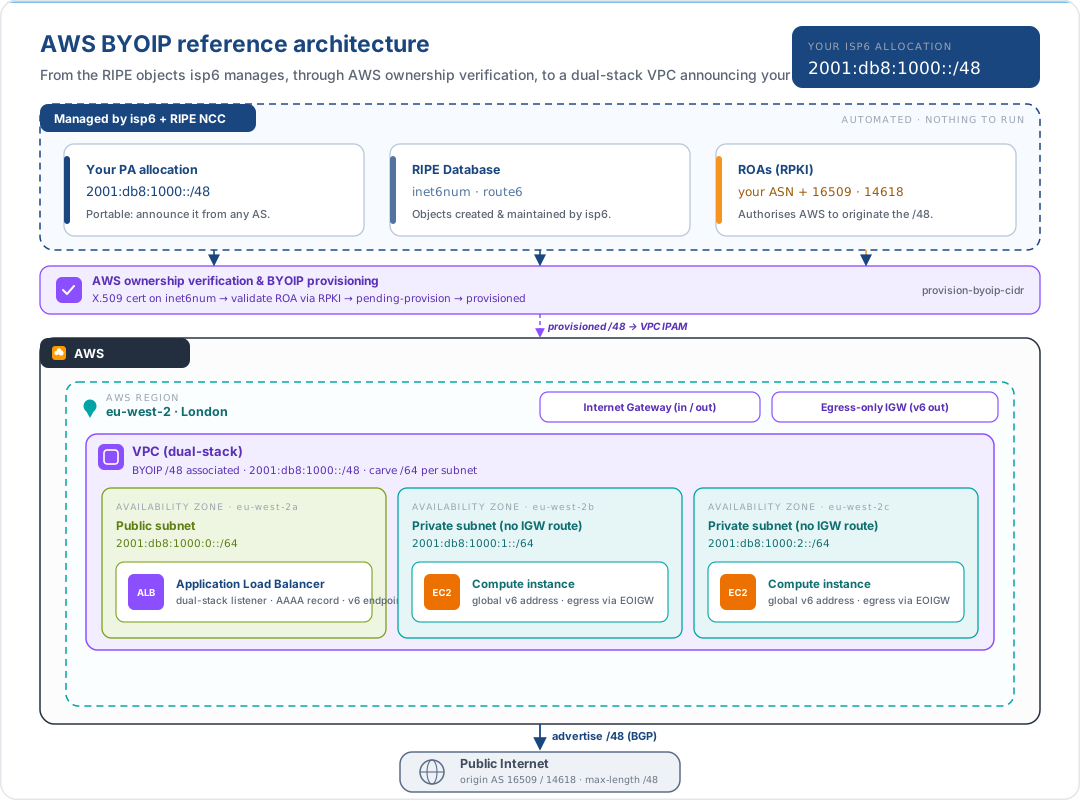
Key Architectural Notes
- No EIP required. Unlike IPv4 BYOIP (which maps to Elastic IPs), IPv6 addresses from your BYOIP pool are assigned directly to ENIs, so there is no intermediate EIP allocation step.
- Egress-Only Internet Gateway replaces NAT Gateway for IPv6 private subnets, providing outbound-only internet access with no processing fee.
- Dual-stack is the recommended deployment model. Associate your BYOIP IPv6 CIDR as a secondary CIDR on the VPC alongside your IPv4 CIDR.
- Your isp6 allocation remains portable. Even after onboarding to AWS, you retain full control through your isp6 dashboard. You can withdraw from AWS and re-announce from another provider at any time.
8. Prerequisites for AWS BYOIP
Because your IPv6 space is already allocated and registered through isp6, several of the traditional BYOIP prerequisites are already satisfied. This section covers what is already in place and what you still need to configure for AWS.
8.1 What isp6 Has Already Done
| Requirement | Status | Detail |
|---|---|---|
| RIPE NCC registration | Done | Your allocation is registered under isp6's LIR |
| inet6num object | Done | Created automatically during order fulfilment |
| Minimum /48 prefix | Done | isp6 allocates /48 and /44 blocks, both meeting AWS's minimum |
| Clean address history | Done | Fresh allocation from isp6's pool, never previously used |
| route6 object | Done | Created when you activate your subnet and submit your ASN |
| ROA for your network | Done | Managed via isp6's RPKI management; propagation status visible in your dashboard |
| RSA key pair | Done | Generated during onboarding via Web Crypto. Public key registered on the RIPE NCC inet6num |
8.2 ROA for AWS ASNs
For AWS to announce your prefix via BGP, you need a ROA that authorises the AWS Autonomous System Numbers. This is managed through isp6's RPKI management, the same mechanism used for your own network's ROA.
| Parameter | Value |
|---|---|
| Origin ASN | 16509 (AWS) and 14618 (AWS / Global Accelerator) |
| Origin ASN (GovCloud) | 8987 (instead of 16509 and 14618) |
| Prefix | Your /48 (or /44) |
| Maximum length | /48 |
Add the AWS ASNs using the cloud panel on your isp6 subnet dashboard, then select your cloud provider and the ASNs are populated automatically. isp6 manages RPKI for your allocation. The ROA is published through isp6's RIPE NCC certification authority, alongside your existing ROA for your own ASN.
ROA propagation via RPKI can take up to 24 hours. Do not proceed to AWS provisioning until the ROA is visible. Your isp6 subnet dashboard displays ROA propagation status, so you can track readiness without leaving the platform.
Important: If your prefix is currently announced from your own ASN (e.g., from on-premises infrastructure), ensure your existing ROA remains in place alongside the AWS ROA. Removing it prematurely will cause a routing disruption.
8.3 Ownership Verification
AWS needs to verify that you control the address space before allowing provisioning. isp6 has already completed the most complex part of this process during your onboarding.
What isp6 has already done:
During onboarding (step 9, "Configure certificate"), the isp6 portal generates an RSA
2048-bit key pair in your browser using the Web Crypto API. The public key is
automatically registered on the RIPE NCC inet6num descr field for your allocation. You
downloaded the corresponding private key at that time; isp6 never stores it.
What you do for AWS:
Use the private key from your isp6 onboarding to create the signed authorisation message
that AWS requires during BYOIP provisioning. This message includes your AWS account ID,
the prefix, and an expiry date. See the
AWS BYOIP Onboarding documentation
for the exact message format and openssl signing commands.
Lost your private key? You can regenerate a new key pair at any time from your isp6 dashboard (
/member/certificate). Regenerating invalidates the previous key, and isp6 will update the public key on the RIPE NCCinet6numautomatically.
Alternative: DNS TXT Record (IPAM only)
If you use VPC IPAM, you can verify ownership by placing a DNS TXT record instead of using the certificate-based method. See Tutorial: BYOIP to IPAM for details.
8.4 AWS Account Limits
| Limit | Value |
|---|---|
| BYOIP CIDRs per region per account | 5 (IPv4 + IPv6 combined) |
| IPv6 CIDRs per VPC | 5 |
9. Implementation Overview
This section outlines the provisioning lifecycle on the AWS side. For exact CLI syntax, signed message construction, and API parameters, refer to the AWS BYOIP Onboarding documentation.
9.1 Provisioning Lifecycle
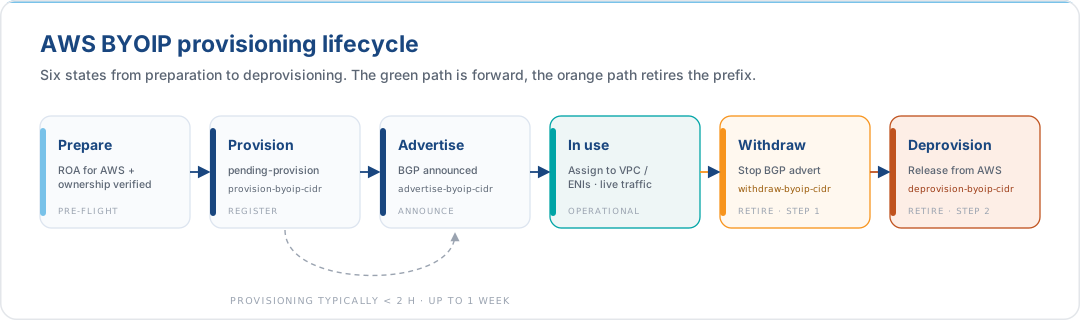
9.2 Step-by-Step Summary
| Step | Action | Notes |
|---|---|---|
| 1 | Add ROA for AWS ASNs | Use the cloud panel on your isp6 subnet dashboard to add ASNs 16509 and 14618. isp6 tracks RPKI propagation, so wait until the dashboard confirms the ROA is visible (up to 24 hours). |
| 2 | Create signed authorisation message | Use the private key from your isp6 onboarding to sign the AWS authorisation message. The public key is already on the RIPE NCC inet6num (registered by isp6 during onboarding). Alternatively, use a DNS TXT record if using IPAM. |
| 3 | Provision the CIDR | Use aws ec2 provision-byoip-cidr (CLI) or the IPAM console. Supply the signed authorisation message. |
| 4 | Wait for provisioning | Status transitions from pending-provision to provisioned. Typically completes within 2 hours, but can take up to 1 week. Monitor with aws ec2 describe-byoip-cidrs. |
| 5 | Advertise the CIDR | Use aws ec2 advertise-byoip-cidr to instruct AWS to begin BGP announcements. Your prefix becomes globally routable via AWS. |
| 6 | Associate with VPC | Add the BYOIP IPv6 CIDR as a VPC CIDR association. AWS allows up to 5 IPv6 CIDRs per VPC. |
| 7 | Assign to resources | Allocate IPv6 addresses from your BYOIP pool to subnets and ENIs (EC2, ALB, NLB, etc.). |
Do not make manual changes to RADb or other Internet Routing Registries. AWS automatically updates RADb when you advertise or withdraw your prefix.
For the complete CLI walkthrough, including signed message construction, see:
10. Monitoring & Security
10.1 Operational Monitoring
| What to Monitor | How | Why |
|---|---|---|
| BYOIP CIDR status | aws ec2 describe-byoip-cidrs or IPAM dashboard |
Detect unexpected state changes (e.g., failed-provision, failed-advertise) |
| IPv6 address utilisation | VPC IPAM metrics, CloudWatch custom metrics | Prevent subnet exhaustion if you are carving many /64s from your allocation |
| BGP advertisement health | AWS Health Dashboard, isp6 subnet dashboard | Confirm your prefix remains visible in the global routing table. isp6 monitors ROA propagation status for your allocation |
| IP reputation | Third-party monitoring (e.g., Spamhaus, Google Postmaster Tools) | Catch reputation degradation early. Your isp6 allocation starts clean, but operational issues can change that |
| isp6 subnet dashboard | Your isp6 account | RIPE NCC registration state, ROA validity and propagation status, and event history, giving a single view of your allocation's health alongside your AWS monitoring |
10.2 IAM Least-Privilege Guidance
Restrict BYOIP lifecycle operations to a dedicated infrastructure team. The key EC2 actions to control are:
| Action | Permission | Risk if Unrestricted |
|---|---|---|
| Provision a new CIDR | ec2:ProvisionByoipCidr |
Unauthorised address onboarding |
| Advertise (start BGP) | ec2:AdvertiseByoipCidr |
Premature or unplanned route announcements |
| Withdraw (stop BGP) | ec2:WithdrawByoipCidr |
Unplanned route withdrawal, causes outage |
| Deprovision (remove from AWS) | ec2:DeprovisionByoipCidr |
Permanent removal of the CIDR from your account |
| Describe (read-only) | ec2:DescribeByoipCidrs |
Low risk, grant broadly for visibility |
Construct your IAM policies using the principle of least privilege. Use Condition keys
to scope Advertise and Withdraw actions to specific CIDR ranges where possible. See
the EC2 IAM Actions documentation
for the full list of BYOIP-related actions and supported condition keys.
10.3 Security Considerations
- RPKI is non-negotiable. Your ROA is what prevents another AS from hijacking your prefix via BGP. isp6 manages your RPKI state and monitors ROA propagation status through your subnet dashboard. An expired or invalid ROA means AWS will cease advertising your range.
- Do not share the RSA private key used to sign the provisioning message. It is not needed after provisioning; store it securely or destroy it per your key management policy.
- SCPs for guardrails. In an AWS Organizations environment, use Service Control
Policies to prevent non-infrastructure accounts from calling
ProvisionByoipCidrorDeprovisionByoipCidr. - ROA changes go through isp6. If you need to modify the ROA (e.g., to change the AWS ASN configuration or add a new provider's ASN), make the change through your isp6 subnet dashboard to avoid disrupting your BGP advertisements.
11. Rollback & Deprovisioning
If you need to revert, whether to move the range to another provider or to troubleshoot a routing issue, the AWS side is the reverse of provisioning. Your isp6 allocation and RIPE NCC registrations remain intact throughout.
| Step | Action | Effect |
|---|---|---|
| 1 | Disassociate from resources | Remove the IPv6 CIDR from VPC associations and release addresses from ENIs |
| 2 | Withdraw advertisement | aws ec2 withdraw-byoip-cidr makes AWS stop BGP announcements. The prefix is no longer globally routable via AWS. |
| 3 | Deprovision the CIDR | aws ec2 deprovision-byoip-cidr releases the range from your AWS account entirely. |
| 4 | Update ROA | Remove ASN 16509/14618 via your isp6 subnet dashboard. Add your new provider's ASN if re-homing. |
| 5 | Clean up certificate (optional) | If you no longer need the public key on the RIPE NCC inet6num, regenerate or remove it from your isp6 dashboard (/member/certificate). |
Your allocation stays yours. Deprovisioning from AWS does not affect your isp6 membership, your RIPE NCC registration, or your ability to re-announce the prefix from another provider. This is the core portability benefit of owning your address space through isp6.
Warning: You must disassociate the CIDR from all VPCs and release all allocated addresses before you can deprovision. AWS will reject the deprovision call if the range is still in use.
Membership expiry warning: If your isp6 membership lapses, isp6 will deprovision the RIPE NCC objects (ROA, route6, inet6num) following the standard lifecycle. This will invalidate the ROA that AWS depends on and cause your prefix to be withdrawn from BGP. Always deprovision from AWS before allowing your membership to expire.
12. Recommendations
-
Start with a /48. The minimum publicly advertisable IPv6 prefix for AWS BYOIP is /48. If you hold a /44 from isp6, decide whether to bring the full /44 or individual /48 slices based on your multi-account strategy.
-
Use IPAM for multi-account environments. If you manage more than 2-3 accounts or multiple regions, the centralised visibility of VPC IPAM prevents orphaned CIDR associations and provides audit trails that manual CLI management cannot.
-
Plan your subnet hierarchy. A /48 gives you 65,536 /64 subnets, but a VPC does not take the whole thing. AWS accepts a VPC IPv6 CIDR of /44 to /60 in increments of /4, and assigns a /56 when you let it choose, so a /56 per VPC is the natural unit: that is 256 VPCs from a /48, each with 256 /64 subnets. Design a consistent allocation scheme (e.g., by environment, by service tier, by AZ) before you start assigning, because retrofitting a numbering plan is painful.
-
Monitor RPKI via your isp6 dashboard. Your isp6 subnet dashboard shows RIPE NCC registration state, ROA validity, and propagation status. Complement this with AWS-side monitoring (
describe-byoip-cidrs) to catch issues early. An expired ROA means AWS will stop advertising your prefix. -
Protect the clean slate. Your fresh isp6 allocation has never been used. Protect that reputation by deploying proper SPF, DKIM, and DMARC records from day one if you use these addresses for outbound email, and by implementing egress filtering to prevent abuse originating from your range.
-
Deploy dual-stack, not IPv6-only (yet). While AWS services increasingly support IPv6-only VPCs, many third-party integrations and SaaS APIs still require IPv4. Run dual-stack with your isp6 BYOIP IPv6 as the primary addressing layer, falling back to IPv4 where necessary.
-
Evaluate CloudFront Anycast Static IPs. As of March 2026, CloudFront supports BYOIP IPv6 via IPAM for Anycast Static IP lists in dual-stack configuration, which is useful if you need deterministic, allowlistable IPs at the CDN edge. See the CloudFront BYOIP announcement.
13. Further Reading
AWS Documentation
- Bring your own IP addresses (BYOIP) to Amazon EC2
- Prerequisites for BYOIP
- Onboard your BYOIP address range
- VPC IPAM: What is IPAM?
- Tutorial: Bring your IPv6 CIDR to IPAM (CLI)
- Tutorial: Bring your IPv6 CIDR to IPAM (Console)
- IPAM Pricing
- AWS VPC Pricing
- Egress-Only Internet Gateway
- IPv6 on AWS: Whitepaper
RIPE NCC References
AWS Blog Posts
- Introducing BYOIP for Amazon VPC
- Bring Your IPv6 Address Space to IPAM
- Understanding IPv6 Addressing on AWS
- CloudFront BYOIP for IPv6 via IPAM (March 2026)
Related isp6 knowledge base articles
- Designing the Next Internet: An Introduction to IPv6: protocol primer for engineers new to IPv6; covers address anatomy, scopes, and SLAAC before you touch the cloud
- Planning Your isp6 Allocation: sizing and structuring your /48 or /44 before you announce it to AWS
- Reference Architectures: AWS: the production topology this guide enables: multi-AZ VPC with ALB / EOIGW, and multi-Region with VPC IPAM and Transit Gateway
- Stop Thinking in IPv4: Misconceptions That Sabotage Your IPv6 Deployment: IPv4 reflexes to unlearn before configuring security groups and NACLs
- Building an IPv6 Integrated Project Team: cross-functional programme structure for a successful AWS rollout
isp6
Bring your own space to AWS
isp6 registers the inet6num and route6 for your /48, you run the BYOIP provisioning, and the prefix stays registered to you for the life of your membership.Get your IPv6 space →
This document is provided for informational purposes. Protocol specifications and cloud provider behaviour are subject to change. Consult the linked RFCs and vendor documentation for authoritative, up-to-date information before making architectural decisions.