description: Building an integrated project team for IPv6 adoption: organising networking, cloud, and security disciplines for delivery across an isp6 allocation programme.
Building an IPv6 Integrated Project Team
Audience: isp6 members, IT leadership, programme managers, and technology directors responsible for IPv6 adoption programmes, particularly those managing cross-functional teams across networking, cloud/systems, and security disciplines.
Last updated: April 2026
1. Introduction
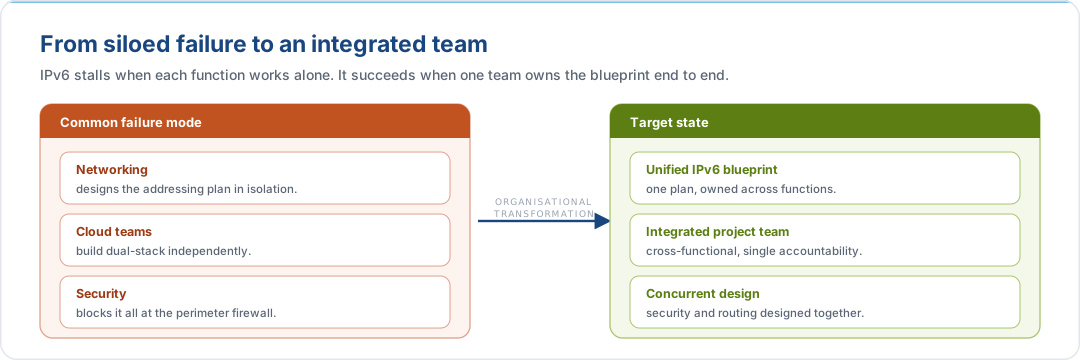
Most IPv6 deployment failures are not technical. The protocol is mature, the RFCs are stable, and the cloud providers have supported it for years. The failure mode is organisational: networking teams design address plans in isolation, cloud teams build dual-stack infrastructure independently, and security teams, untrained and uninvolved, block the deployment at the perimeter firewall.
The most beautifully engineered IPv6 network is entirely useless if no actual user traffic ever touches it.
This article examines why IPv6 adoption is fundamentally a cross-functional organisational challenge, not a networking project, and provides a framework for building the integrated team structure that successful deployments require. It draws on established organisational models (Team Topologies, Westrum's culture typology, and Kotter's change management framework) to give programme managers a structured approach to an initiative that too often drifts into technical silos.
For isp6 members, the good news is that a significant portion of the specialist complexity (RIPE NCC registration, RPKI and ROA management, route6 objects, and ongoing compliance) is already handled by isp6 as a service. This article shows where that fits within the team structure so your organisation can focus on the cross-functional coordination that actually determines success or failure.
2. The Siloed Deployment Anti-Pattern
IPv6 deployments that follow the traditional waterfall handoff between functional teams exhibit a predictable cascading failure:
Phase 1: Networking
The networking team, often the most IPv6-literate group in the organisation, charges ahead. They design a global addressing plan, configure routing protocols for dual-stack operation, and allocate prefixes from the organisation's RIPE NCC allocation. The work is technically sound, thoroughly documented, and delivered on schedule.
Phase 2: Cloud and Systems
Cloud and platform teams begin independently. They provision IPv6 CIDRs in AWS VPCs, configure dual-stack load balancers, and update Terraform modules. They may or may not reference the networking team's address plan. Dual-stack infrastructure is built, but host-level concerns (address selection policy, application binding, DNS AAAA record publication) receive inconsistent attention.
Phase 3: Security
The security team encounters IPv6 traffic for the first time at the perimeter firewall. They have not been trained on ICMPv6 filtering requirements (RFC 4890), do not understand why "block all ICMP" breaks Neighbor Discovery, and have no IPv6-specific threat model. Faced with uncertainty, they apply the only risk mitigation available to an uninformed team: block everything.
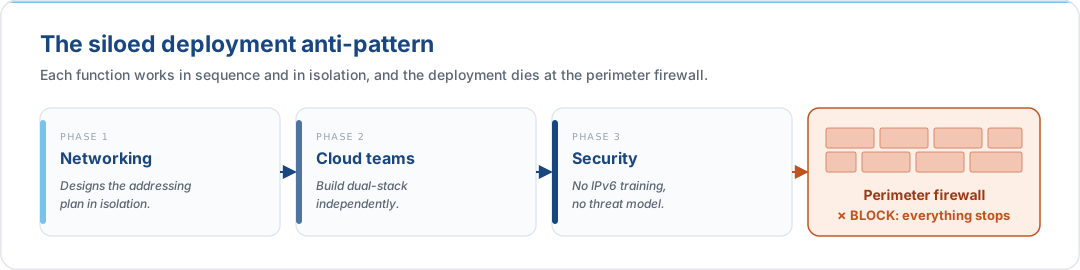
The deployment stalls, not because of a technical deficiency, but because the organisation treated IPv6 as a sequential infrastructure project rather than a cross-cutting capability change.
Gene Kim's The Phoenix Project identifies this exact failure mode: functional silos optimising locally while the end-to-end value stream (in this case, IPv6 traffic reaching users) is blocked by handoff friction and knowledge gaps. Kim's First Way (systems thinking and left-to-right flow) demands that the entire delivery chain, from prefix allocation to firewall policy, be designed as a single system.
3. Case Study: The US Department of Defense
The US Department of Defense provides the most extensively documented example of organisational failure in IPv6 adoption.
In 2003, the DoD issued a mandate requiring all networked systems to be IPv6-capable. The initiative was abandoned due to security risks and a lack of trained personnel. In 2020, the Government Accountability Office published GAO-20-402, "Internet Protocol Version 6: DOD Needs to Improve Transition Planning," which examined why the earlier effort failed and assessed the DoD's readiness for a renewed mandate.
Key Findings
| Finding | Implication |
|---|---|
| Failure to train and engage security personnel early was cited as a primary cause of the abandoned 2003 effort | Security teams defaulted to blocking what they did not understand, the same pattern seen in enterprise deployments |
| The DoD had not inventoried its IP-capable devices | Without an asset inventory, scoping the transition is impossible |
| No realistic cost estimates existed for the transition | Programme governance requires cost baselines; IPv6 was treated as a technical task without programme-level planning |
| GAO made three formal recommendations: inventory devices, estimate costs, and develop risk-based transition plans | All three are programme management activities, not networking tasks |
The GAO report is notable because every recommendation it made was organisational, not technical. The DoD did not lack routing engineers who could configure OSPFv3. It lacked a programme structure that treated IPv6 as a cross-functional capability requiring coordinated training, planning, and governance.
4. Organisational Culture and IPv6 Readiness
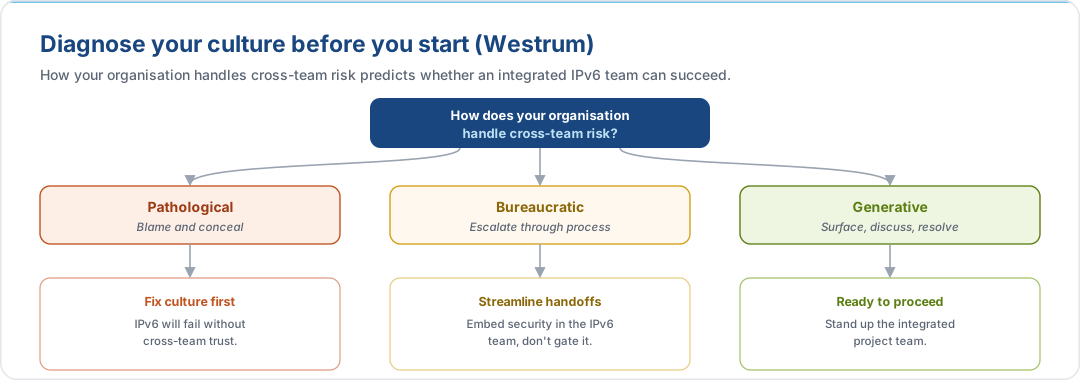
Ron Westrum's typology of organisational cultures, originally published in the context of healthcare safety and later applied to technology organisations by the DORA (DevOps Research and Assessment) programme, provides a diagnostic lens for IPv6 readiness.
Westrum's Three Culture Types
| Characteristic | Pathological (Power) | Bureaucratic (Rules) | Generative (Performance) |
|---|---|---|---|
| Information flow | Hoarded for political advantage | Flows through formal channels only | Flows freely to where it is needed |
| Cross-team cooperation | Discouraged; teams are rivals | Tolerated within process boundaries | Actively sought; mission over turf |
| Failure response | Scapegoating | Process tightening | Root-cause inquiry and learning |
| New ideas | Crushed | Create problems (process deviation) | Welcomed and investigated |
| Risk management | Concealed | Procedural compliance | Shared ownership; risks surfaced early |
The DORA research, published in Accelerate (Forsgren, Humble, Kim, 2018), demonstrated that generative culture is a statistically significant predictor of both software delivery performance and organisational outcomes. For IPv6 adoption, the cultural type determines how cross-functional friction is handled:
- Pathological: The networking team hoards IPv6 expertise as a power base. Security blocks the deployment and blames networking for "creating risk." The programme dies in political crossfire.
- Bureaucratic: Each team follows its own change process. Networking files a change request; security opens a review ticket; months pass. IPv6 is technically approved but operationally stalled by sequential handoffs and approval queues.
- Generative: Networking, security, and cloud teams form a joint working group from day one. Security raises ICMPv6 filtering concerns during the addressing design phase, not after deployment. Risks are surfaced, discussed, and resolved as a shared problem.
Diagnosing Your Organisation
Before launching an IPv6 programme, assess which cultural pattern dominates your infrastructure teams. If the answer is pathological or bureaucratic, the organisational change work must begin before the technical work, or it will be consumed by it.
5. Mapping IPv6 Roles to Team Topologies
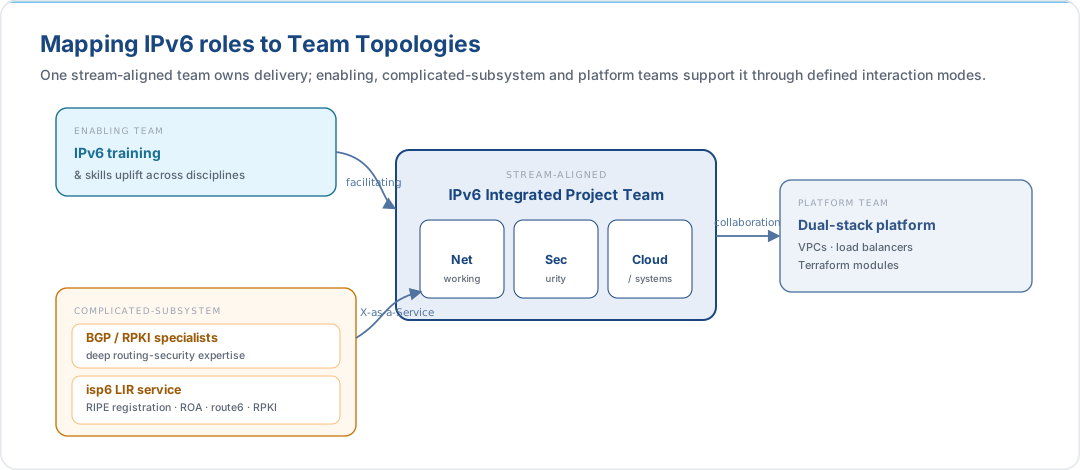
Matthew Skelton and Manuel Pais's Team Topologies (IT Revolution Press, 2019) provides a vocabulary for structuring teams around the flow of change rather than around functional specialisations. The model defines four fundamental team types and three interaction modes.
The Four Team Types
| Team Type | Definition | IPv6 Mapping |
|---|---|---|
| Stream-aligned | Delivers value directly to users/customers; owns the end-to-end flow for a product or service | The IPv6 Integrated Project Team itself, owning the end-to-end flow from prefix allocation through to IPv6 traffic reaching production workloads |
| Enabling | Helps other teams acquire new capabilities; time-limited engagement focused on skill transfer | An IPv6 skills team that delivers training, pair-configures firewalls with security engineers, and disbands once the capability is embedded |
| Complicated-subsystem | Owns an area requiring deep specialist knowledge that most teams cannot reasonably develop | BGP/routing specialists, RPKI/ROA management, or IPsec tunnel engineering: deep protocol expertise that the stream-aligned team consumes but does not need to own. For isp6 members, isp6 itself acts as an external complicated-subsystem provider, managing RIPE NCC registration, RPKI, ROA creation, route6 objects, and ongoing compliance so your IPT does not need to staff or build this capability in-house |
| Platform | Provides internal self-service capabilities that reduce cognitive load on stream-aligned teams | The infrastructure platform team that provides dual-stack VPCs, IPv6-enabled load balancers, and self-service subnet allocation as a product |
The Three Interaction Modes
| Mode | Definition | IPv6 Application |
|---|---|---|
| Collaboration | Two teams work closely together for a defined period to solve a shared problem | Networking and security co-designing ICMPv6 firewall policy during the initial deployment phase |
| X-as-a-Service | One team consumes another's capability through a well-defined API or interface | Application teams consuming IPv6-enabled subnets from the platform team via Terraform modules, with no need to understand BGP or RIPE NCC registration |
| Facilitating | An enabling team coaches another team to build a new skill | The IPv6 enabling team running workshops with the security team on NDP, ICMPv6 filtering, and IPv6 threat modelling |
Why This Matters for IPv6
The traditional model, a "networking project" staffed by network engineers, maps to a single complicated-subsystem team working in isolation. It produces technically excellent routing configurations that never reach users because the stream-aligned teams (application delivery) and the platform teams (cloud infrastructure) were not part of the design.
Team Topologies reframes the question: Who owns the end-to-end flow of IPv6 traffic from allocation to production? That owner is the stream-aligned team, the Integrated Project Team, and it must include representatives from every discipline that IPv6 touches.
IPv6 natively bridges the gap between network transport and host OS behaviour, address selection (RFC 6724), SLAAC, and NDP operate at the intersection of networking, systems, and security. A deployment model that treats these as separate domains will fail at exactly those intersection points.
6. Building the Integrated Project Team
The Integrated Project Team (IPT) is a cross-functional group with a single mandate: deliver end-to-end IPv6 connectivity from prefix allocation to production traffic. It is not a committee, a working group, or a review board. It is a delivery team with shared accountability for outcomes.
Composition
| Discipline | Role in the IPT | Key Responsibilities |
|---|---|---|
| Networking | Prefix architecture and routing | Address plan design, BGP/OSPFv3 configuration, peering and transit. Must step out of the core-router vacuum and engage with host-level and application-level concerns. For isp6 members, RIPE NCC registration, route6 objects, and ROA management are handled by isp6, so the networking discipline focuses on how to deploy the allocation, not how to register it |
| Cloud / Systems | Host and platform integration | Dual-stack VPC provisioning, host address selection policy, SLAAC/DHCPv6 configuration, application binding (listen on [::]), DNS AAAA publication, BYOIP onboarding. isp6 provides BYOIP guides for AWS, Azure, and Google Cloud covering exactly what the cloud team needs to configure |
| Security | Policy, threat modelling, and compliance | ICMPv6 firewall policy (RFC 4890), NDP security, IPv6 threat model, flow telemetry for host discovery (replacing subnet scanning), compliance framework updates |
| Programme management | Governance and delivery | Milestone tracking, risk register, stakeholder communication, training coordination, budget management. Owns the programme plan, not the technical decisions |
Operating Principles
-
Single source of truth. The IPT maintains one IPv6 addressing and policy blueprint. There is no separate "networking address plan" and "security firewall policy". They are sections of the same document, reviewed and approved together.
-
Concurrent design, not sequential handoff. Security policy is designed at the same time as the addressing plan, not after it. Cloud provisioning is planned in parallel with routing, not as a follow-on phase. This eliminates the cascading failure described in Section 2.
-
Embed, don't gate. Security is a member of the IPT, not an external review gate. If security concerns are raised during design, they are resolved within the team. If they are raised after deployment by an external review board, the programme is structurally broken.
-
Time-box the collaboration. Per Team Topologies, close collaboration between teams is cognitively expensive and should be time-limited. The IPT operates in intensive collaboration mode during the design and initial deployment phases, then transitions to an X-as-a-Service model where the platform team provides self-service IPv6 capabilities and the IPT disbands or scales down to a maintenance function.
-
Measure traffic, not configuration. The success metric is not "IPv6 is configured". It is "IPv6 traffic is flowing in production." Instrument your deployment to measure the percentage of traffic using IPv6 from day one.
7. Leading the Transition: Kotter's 8-Step Model
John Kotter's eight-step model for leading organisational change (Leading Change, Harvard Business School Press, 1996) provides a proven structure for IPv6 adoption programmes. IPv6 is not a technology upgrade. It is a capability change that requires new skills, new processes, and new ways of working across team boundaries.
| Step | Kotter's Model | IPv6 Programme Application |
|---|---|---|
| 1 | Create urgency | IPv4 exhaustion is real: RIPE NCC has been on its last /8 since 2019. AWS charges for public IPv4 ($0.005/hr per address, ~$43.80/year). IPv6-only services (Apple App Store review, T-Mobile US) are growing. Frame IPv6 not as a future concern but as an operational cost and capability gap today |
| 2 | Build a guiding coalition | Assemble the IPT sponsors: a networking director, a CISO or security architect, a cloud platform lead, and a programme manager. Without security leadership in the coalition, the deployment will stall at Phase 3 |
| 3 | Form a strategic vision | "All new workloads deploy dual-stack by default. IPv6 is the primary protocol; IPv4 is the compatibility layer." A clear, directional statement that teams can align to |
| 4 | Enlist a volunteer army | Identify IPv6 champions in each team: engineers who are curious, have lab experience, or have deployed IPv6 elsewhere. These are your enabling team members who will drive adoption from within |
| 5 | Enable action by removing barriers | Procure training (RIPE NCC courses, vendor labs). Update firewall change processes to include ICMPv6 baseline rules. Provide self-service IPv6 subnet allocation from the platform team. Remove the friction that makes IPv4 the path of least resistance |
| 6 | Generate short-term wins | Deploy a non-critical workload on dual-stack and demonstrate it working. Publish the first AAAA record. Show IPv6 traffic flowing in monitoring dashboards. Early, visible wins build credibility and momentum |
| 7 | Sustain acceleration | Expand from the pilot to additional workloads, regions, and environments. Each success reduces the perceived risk and increases organisational confidence. Do not declare victory after one deployment |
| 8 | Institute change | Update the organisation's default posture: new VPCs are dual-stack, new security group templates include ICMPv6 baselines, new applications bind to [::]. IPv6 is no longer a project; it is how the organisation operates |
The Critical Step: Number 5
Most IPv6 programmes fail at step 5. The barriers are not technical. They are procedural and educational:
- Security teams lack IPv6 training and default to blocking what they do not understand
- Firewall change processes do not include IPv6-specific templates or baselines
- Platform teams have not updated their Terraform modules / CloudFormation templates for dual-stack
- Application teams do not know how to bind to IPv6 or test dual-stack connectivity
Removing these barriers is the programme manager's primary responsibility. It is not glamorous work, but it is the work that determines whether the programme succeeds or produces another shelf of unused documentation.
8. The IPv6 Success Framework
Successful IPv6 adoption rests on two pillars. Technical competence without organisational alignment produces an engineered network that nobody uses. Organisational alignment without technical competence produces a programme that cannot deliver. Both pillars must be built concurrently.
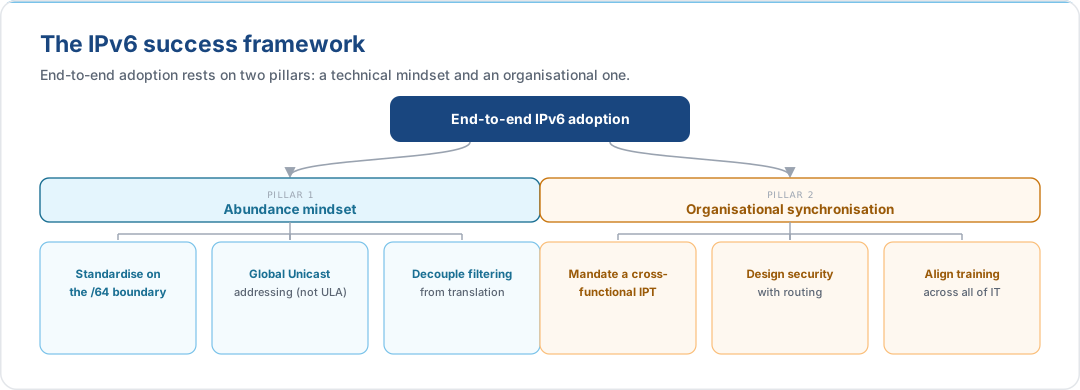
Pillar 1: Abundance Mindset
Stop applying IPv4 scarcity constraints to a protocol designed for abundance:
- Standardise on /64. Every end-host subnet gets a /64, with no exceptions. Do not carve smaller prefixes to "conserve" space (RFC 7421).
- Use Global Unicast Addresses. Do not default to ULA as a replacement for RFC 1918. GUA behind stateful firewalls provides equivalent security without the address selection problems of RFC 6724.
- Decouple filtering from translation. Firewalls provide security; NAT provided address sharing. In IPv6, these are separate concerns. Design your security posture around stateful filtering, not address translation (RFC 4864).
For a detailed treatment of these technical misconceptions, see Stop Thinking in IPv4: Misconceptions That Sabotage Your IPv6 Deployment.
Pillar 2: Organisational Synchronisation
Stop building in functional silos:
- Mandate a cross-functional IPT. Networking, cloud/systems, and security must be represented in a single delivery team with shared accountability. Use the Team Topologies model to structure the team and its interactions.
- Design security concurrently with routing. Security policy is not a review gate after the network is built. It is a design input from day one. The ICMPv6 filtering baseline, the IPv6 threat model, and the flow telemetry strategy are all designed alongside the address plan.
- Align training across disciplines. Every member of the IPT needs IPv6 training, not just the networking engineers. Security teams need ICMPv6 and NDP training. Cloud teams need BYOIP and dual-stack provisioning training. Use the RIPE NCC's free training courses at learning.ripe.net as a baseline.
Successful IPv6 deployment is 50% unlearning old technical constraints and 50% dismantling operational silos.
9. Recommendations
| # | Recommendation | Owner |
|---|---|---|
| 1 | Assess organisational culture using Westrum's typology before launching the programme. If the culture is pathological or bureaucratic, address this first, because the IPv6 work will not survive cross-team friction | Programme sponsor |
| 2 | Form the Integrated Project Team with representatives from networking, cloud/systems, security, and programme management. This is a delivery team, not a steering committee | Programme manager |
| 3 | Invest in training across all disciplines. Use RIPE NCC's free IPv6 training courses. Budget for vendor-specific training (AWS, Azure, GCP) on dual-stack and BYOIP. isp6's knowledge base provides cloud-specific BYOIP guides and technical reference material for your team | Programme manager |
| 4 | Create a single IPv6 blueprint covering addressing, routing, security policy, and platform integration. Maintain it as one document owned by the IPT | IPT collectively |
| 5 | Design security policy concurrently with the address plan. Include ICMPv6 baselines, NDP security, and flow telemetry from the start | Security lead within IPT |
| 6 | Start with a non-critical pilot to generate a short-term win (Kotter step 6). Deploy a staging or internal workload on dual-stack and measure IPv6 traffic flow | IPT collectively |
| 7 | Measure traffic, not configuration. The success metric is the percentage of production traffic using IPv6, not the number of interfaces configured | Programme manager |
| 8 | Plan the team's evolution. The IPT operates in collaboration mode during design and initial deployment, then transitions to X-as-a-Service as IPv6 becomes the default. Budget for both phases | Programme sponsor |
10. References
Organisational Models and Change Management
| Source | Author(s) | Publisher / Year | Relevance |
|---|---|---|---|
| Team Topologies: Organizing Business and Technology Teams for Fast Flow | Matthew Skelton, Manuel Pais | IT Revolution Press, 2019 | Four team types and three interaction modes for structuring cross-functional delivery teams |
| Accelerate: The Science of Lean Software and DevOps | Nicole Forsgren, Jez Humble, Gene Kim | IT Revolution Press, 2018 | DORA research demonstrating the link between generative culture and delivery performance; applies Westrum's typology to technology organisations |
| Leading Change | John P. Kotter | Harvard Business School Press, 1996 | Eight-step model for leading organisational change; directly applicable to IPv6 adoption programmes |
| The Phoenix Project: A Novel About IT, DevOps, and Helping Your Business Win | Gene Kim, Kevin Behr, George Spafford | IT Revolution Press, 2013 | The Three Ways (Flow, Feedback, Continual Learning); illustrates the cost of functional silos in technology delivery |
| The Unicorn Project | Gene Kim | IT Revolution Press, 2019 | The Five Ideals of DevOps, including Locality and Simplicity, and Psychological Safety; reinforces the case for small, empowered, cross-functional teams |
| "A Typology of Organisational Cultures" | Ron Westrum | Quality and Safety in Health Care, 2004 | Original paper defining pathological, bureaucratic, and generative culture types |
| DORA: Generative Organizational Culture | DORA / Google Cloud | Online | Application of Westrum's typology to technology delivery performance |
Government and Institutional Reports
| Source | Reference | Year | Relevance |
|---|---|---|---|
| Internet Protocol Version 6: DOD Needs to Improve Transition Planning | GAO-20-402 | 2020 | US Government Accountability Office report documenting the organisational failures of the DoD's IPv6 mandate; all three recommendations were programme management activities |
| Guidelines for the Secure Deployment of IPv6 | NIST SP 800-119 | 2010 | NIST guidance on IPv6 security, including deployment planning and transition strategy |
IPv6 Training and Deployment Guidance
| Source | Publisher | Relevance |
|---|---|---|
| RIPE NCC IPv6 Info Centre | RIPE NCC | Phased deployment planning guide covering address allocation, routing, reverse DNS, and IRR registration |
| RIPE NCC Training Courses | RIPE NCC | Free IPv6 training: Basic (1 day), Advanced (2 days with labs), and Security (1 day) |
| RIPE-690: Best Current Operational Practice for Operators: IPv6 Prefix Assignment for End-Users | RIPE NCC | Operational guidance for IPv6 prefix assignment policies |
Technical References
| RFC | Title | Relevance |
|---|---|---|
| RFC 4890 | Recommendations for Filtering ICMPv6 Messages in Firewalls | The authoritative guide to ICMPv6 firewall policy, and the document security teams must read before configuring IPv6 firewalls |
| RFC 6724 | Default Address Selection for IPv6 | Default address selection policy table; explains why ULA is deprioritised below IPv4 on dual-stack hosts |
| RFC 7421 | Analysis of the 64-bit Boundary in IPv6 Addressing | Why every end-host subnet must be a /64 |
| RFC 4864 | Local Network Protection for IPv6 | How IPv6 achieves NAT-equivalent protection without address translation |
Related Articles
- Designing the Next Internet: An Introduction to IPv6: an accessible primer to share with cross-functional team members who need a baseline understanding of the protocol before joining the programme
- Stop Thinking in IPv4: Misconceptions That Sabotage Your IPv6 Deployment: technical companion covering the six most common IPv4 reflexes that harm IPv6 deployments
- Planning Your isp6 Allocation: sizing and structuring a /48 or /44, the architect's counterpart to the programme-level framing in this article
- Bring Your Own IPv6 to AWS: step-by-step guide for isp6 members, covering what isp6 handles vs. cloud-side configuration
- Bring Your Own IPv6 to Azure: Custom IP Prefix onboarding for isp6 members
- Bring Your Own IPv6 to Google Cloud: PAP/PDP model for isp6 members
Give the programme something to build on
An IPv6 programme stalls without address space to design against. isp6 assigns a /48 as soon as you have joined, self-service, with no RIPE NCC application to wait on.Get your IPv6 space →
This document is provided for informational purposes. Protocol specifications and cloud provider behaviour are subject to change. Consult the linked RFCs and vendor documentation for authoritative, up-to-date information before making architectural decisions.