/44 or /48? Sizing IPv6 by Site and Region
Audience: isp6 members and prospective members deciding which allocation to order, and cloud and network architects translating that decision into an AWS deployment. This guide sizes by how many independently-routable sites you run. Its companion, Planning Your isp6 Allocation, sizes by bit budget (how deep your internal hierarchy needs to be). Read both, as they are two lenses on the same decision. For the AWS BYOIP mechanics referenced here, see Bring Your Own IPv6 to AWS.
Last updated: May 2026
1. The one rule that decides it
isp6 offers two allocation sizes: a /48 and a /44. There is a lot of arithmetic you can do to choose between them, but most of the time a single rule settles it:
Every site or cloud Region that needs its own internet-facing presence needs its own /48, because /48 is the longest IPv6 prefix the global routing table will carry. A /44 is sixteen /48s.
So the question is not really "how many addresses do I need?" (in IPv6 you will never run out inside a /48) but "how many places will independently announce my address space to the internet?"
- One place: one data centre, one cloud Region, or a proof of concept → a /48.
- Several places: multiple Regions, multiple data centres, an active/active estate → a /44, carved into one /48 per location.
The rest of this article explains why the /48 boundary exists, then walks through the single-site and multi-Region cases with AWS reference architectures.
2. Why /48 is the unit of internet routing
A /48 is special. It is the longest (most specific) IPv6 prefix that you can rely on being accepted across the public internet. Network operators routinely filter announcements longer than /48 to keep the global routing table manageable, following long-standing RIPE and operator-community guidance. Announce a /56 or a /64 to the internet and most networks will simply discard it; announce a /48 and it propagates everywhere.
This boundary has direct, practical consequences on AWS:
- AWS BYOIP advertises a /48 at its most specific. The most specific IPv6 range you can bring and have AWS advertise on the public internet is a /48, exactly the global filtering boundary. (See AWS BYOIP to AWS.)
- AWS BYOIP is a per-Region resource. You
provision-byoip-cidrandadvertise-byoip-cidrwithin a Region. The same /48 cannot be provisioned and advertised from two Regions at once, so a second Region that needs to announce your space needs a second /48.
Put those two facts together and the sizing rule writes itself. The /48 is both the smallest independently-routable unit and a per-Region resource, so the number of /48s you need is the number of Regions (or sites) that will independently reach the internet.
What about inside a /48? A /48 still gives you 65,536 /64 subnets to structure however you like: per-AZ, per-environment, per-service. The /48 boundary is about what the outside world routes, not about how much you can subnet internally. Internal depth is the subject of the bit-budget method.
3. The decision in one picture
The choice runs along a single axis, from the simplest possible deployment to a resilient, globally-distributed estate. As you add independently-routable sites, you add /48s, and sixteen of them make a /44.
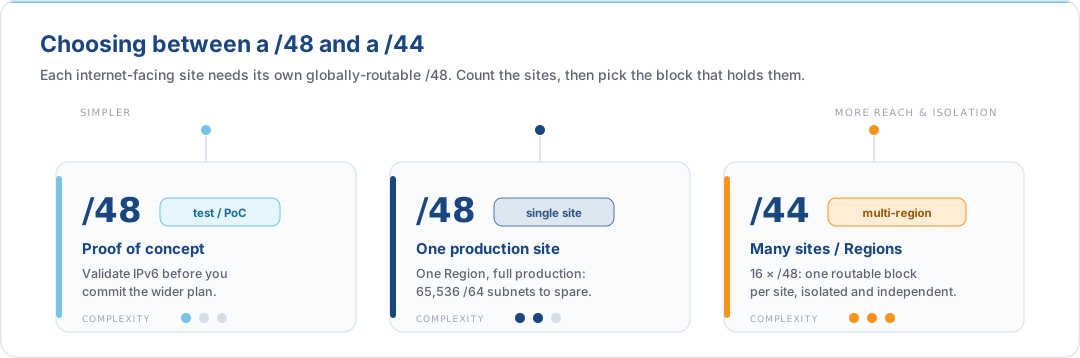
The three stops on that spectrum map to the three architectures in the next two sections, in order of increasing complexity.
4. When a /48 is the right choice
A single /48 is the right answer whenever your address space will be announced from one place. That covers two very common situations.
4.1 Testing an IPv6 rollout
If you are validating IPv6 before committing, proving that SLAAC, security groups, Egress-only Internet Gateways and BYOIP advertisement all behave as expected, a single /48 in one Region is everything you need. There is no IPAM to stand up and nothing to plan beyond the proof of concept itself; you can provision and withdraw the /48 with a couple of CLI calls.
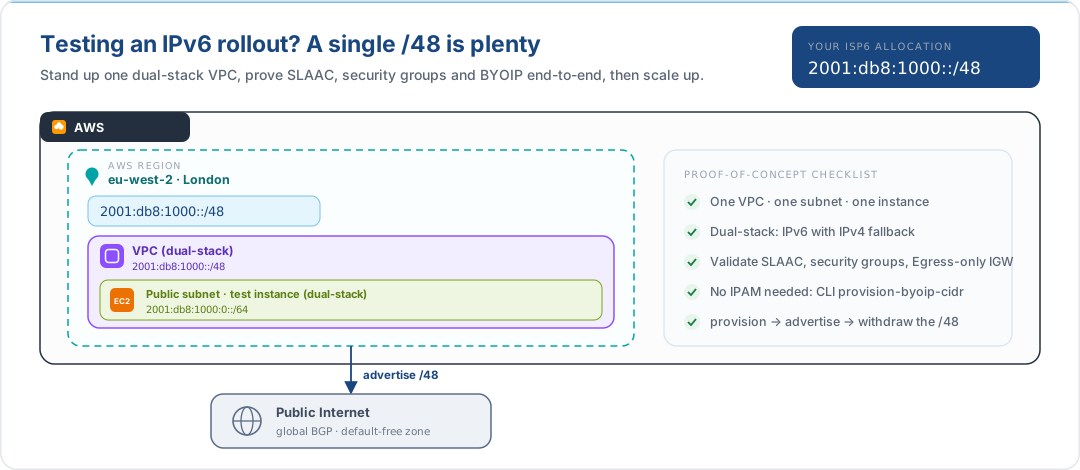
Because nothing here is hard to reverse, this is the recommended way to start. Prove the mechanics on a /48, then size your production allocation with confidence.
4.2 A single production site
A single production Region or data centre is also a /48 deployment, just a fuller one. One dual-stack VPC spans two or more Availability Zones, each with public and private /64 subnets, an Internet Gateway for inbound and an Egress-only Internet Gateway for outbound-only private workloads. The whole site advertises a single /48.
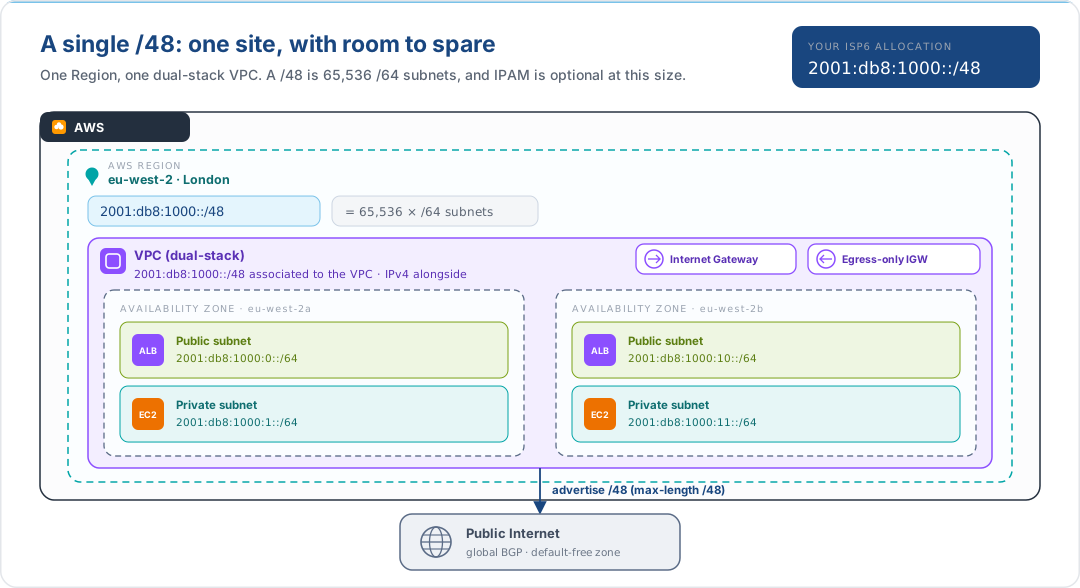
A /48 here is not a compromise. It is the correct size. You would only outgrow it by adding another routable location, which is precisely the trigger for a /44.
5. When you need a /44: multi-Region and multi-DC
The moment you run in more than one Region or data centre and each needs to reach the internet on its own (for latency, for resilience, or to contain the blast radius of a regional failure), you cross from /48 territory into /44 territory.
5.1 Why each Region wants its own /48
Recall the two facts from Section 2: /48 is the most specific globally-routable prefix, and AWS BYOIP is per-Region. So a multi-Region estate cannot share one /48 across Regions. Each Region provisions and advertises its own /48. Giving every Region a distinct /48 also buys you real operational properties:
- Regional ingress. Each Region announces its own prefix, so traffic enters close to where it is served rather than transiting from a single advertising Region.
- Blast-radius isolation. A routing problem, a withdrawal, or an RPKI issue in one Region's /48 does not touch the others.
- Independent lifecycle. You can provision, advertise, withdraw, or migrate one Region's /48 without coordinating a change across the whole estate.
Sixteen /48s fit in a /44, enough for sixteen Regions or sites, with headroom most organisations never exhaust.
5.2 Reference architecture: a /44 across three AWS Regions with IPAM
At multi-Region scale, manage the space with Amazon VPC IPAM. Bring your isp6 /44 into a top-level IPAM pool, then carve a regional /48 pool for each Region. Each Region's VPC draws a /56 from its regional pool, subnets take /64s, and each Region independently advertises its /48.
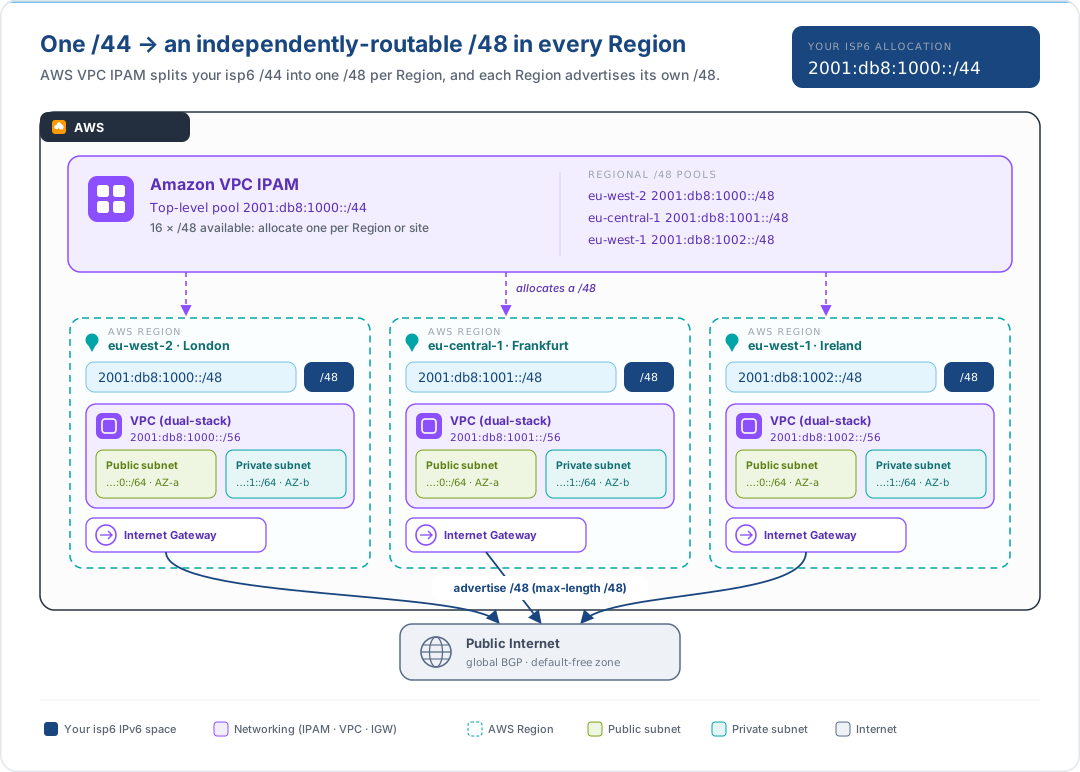
This is also the natural shape for a multi-account strategy: hand one /48 per account (or per account and Region) from IPAM, and every team gets a clean, independently-routable block without renumbering. The same pattern applies beyond AWS: a /44 lets you put a /48 in a colocation facility, a /48 on-premises, and a /48 in each cloud, all from one isp6 allocation and all portable via BYOIP.
6. /48 vs /44 at a glance
| /48 | /44 | |
|---|---|---|
| Independently-routable blocks | 1 (the /48 itself) | 16 × /48 |
| /64 subnets | 65,536 | 1,048,576 |
| Best for | Single site, single Region, proof of concept | Multi-Region, multi-DC, multi-account, active/active |
| AWS footprint | One Region, one BYOIP CIDR | One /48 provisioned per Region |
| IPAM | Optional: CLI is fine for one /48 | Recommended: top-level pool + regional /48 pools |
| Internet advertisement | One /48 from one Region | One /48 from each Region, independently |
| Headroom | 65,536 /64s inside one site | 16 routable locations |
| Order from isp6 | isp6 membership | isp6 membership |
A useful tie-breaker: if you can foresee a second routable location within the life of the deployment (a DR Region, a new market, a cloud migration), order the /44 now. Adding the sixteen-fold headroom up front is far cheaper than renumbering or stitching together discontiguous /48s later.
7. Common sizing mistakes
| Mistake | Why it bites | Do this instead |
|---|---|---|
| "We'll just announce a /56 per Region from one /48" | Anything longer than /48 is filtered on the public internet, so the /56 never propagates | Give each Region its own /48 (so, a /44) |
| Sizing a single site as a /44 "to be safe" | A /48 already holds 65,536 /64s; the extra bits add nothing for one routable location | Order a /48; revisit only when a second location appears |
| Treating /44 vs /48 as purely an address-count question | IPv6 address counts are effectively unlimited at both sizes; the real driver is routable locations and internal hierarchy depth | Combine this site-count lens with the bit-budget method |
| Trying to share one /48 across two AWS Regions | AWS BYOIP is per-Region; the same /48 cannot be advertised from two Regions | One /48 per Region, carved from a /44 |
| Sequentially packing /48s out of a /44 | Leaves no contiguous room for a site to grow or for a new neighbour | Apply the bisection method when handing out /48s |
8. How this maps to your isp6 order
Sizing the allocation is your decision; registering and maintaining it is isp6's.
| Activity | Owner |
|---|---|
| Counting routable sites / Regions and choosing /48 or /44 | You |
| Allocating the /48 or /44 from isp6's RIPE NCC pool | isp6 |
inet6num and route6 registration in the RIPE Database |
isp6 |
| RPKI ROA creation and propagation monitoring (incl. cloud-provider ASNs) | isp6 |
| Reverse DNS delegation | isp6 |
| Carving the allocation into per-Region /48s and per-VPC /56s (IPAM) | You |
| AWS BYOIP provisioning and advertisement, per Region | You, see the AWS guide |
Whichever size you order, the allocation is portable PA space: you can announce it from AWS, Azure, Google Cloud, a colocation facility, on-premises, or several of these at once, and move it between them for the life of your membership, without renumbering on the consumer side. That portability is exactly what makes the /44 multi-location pattern in Section 5 work.
9. Further reading
Related isp6 knowledge base articles
- Planning Your isp6 Allocation: the bit-budget companion to this guide: how deep your internal hierarchy needs to be, the nibble boundary, IPAM, and the bisection method
- Reference Architectures: An Overview: the next step once you've sized: what to actually build per target (AWS, Azure, Google Cloud, on-prem / colo) with full SVG topology diagrams
- IPv6 Prefix Chart: quick reference for prefix sizes and the blocks they contain
- Designing the Next Internet: An Introduction to IPv6: address anatomy, scopes, and the /64 boundary
- Bring Your Own IPv6 to AWS: BYOIP mechanics, VPC IPAM, ownership verification, and the per-Region provisioning lifecycle referenced throughout this article
- Bring Your Own IPv6 to Azure · Bring Your Own IPv6 to Google Cloud
- Stop Thinking in IPv4: the IPv4 reflexes (subnet conservation, NAT) to unlearn before you size
RIPE NCC and IETF references
- RIPE NCC IPv6 Address Allocation and Assignment Policy (ripe-738)
- RFC 6177: IPv6 Address Assignment to End Sites: the basis for /48-per-site thinking
- RFC 7454: BGP Operations and Security: prefix-filtering practice behind the /48 routing boundary
AWS documentation
- Bring your own IP addresses (BYOIP) to Amazon EC2
- VPC IPAM: What is IPAM?
- Tutorial: Bring your IPv6 CIDR to IPAM
Not sure whether to order a /48 or a /44?
Count the sites and Regions that will announce your space to the internet. One location is a /48; several is a /44. isp6 assigns either from its RIPE NCC allocation, registered in the RIPE Database once you have joined and portable across every cloud, colo, and on-premises network for the life of your membership.Get your IPv6 space →
This document is provided for informational purposes. Protocol specifications and cloud provider behaviour are subject to change. Consult the linked RFCs and vendor documentation for authoritative, up-to-date information before making architectural decisions.