Deploying IPv6-first EKS on AWS: the gaps, and what it saves
Field notes for platform and network engineers considering an IPv6-first deployment on AWS. Written by the team that runs the isp6 platform. Last updated: October 2026.
Since 1 February 2024, AWS charges $0.005 per hour for every public IPv4 address, about $3.65 a month, per address, across every service. For a conventional three-AZ EKS setup that adds up quietly: NAT gateway EIPs, load balancer addresses, the odd bastion. The charge made IPv6-first architectures financially interesting for the first time.
We had an additional motive. isp6 is a RIPE NCC LIR whose entire product is making IPv6 adoption easy, so running our own platform on IPv4 would have been embarrassing. We built our order-management platform as IPv6-first EKS, with each environment's VPC carrying a /56 from our own PA assignment via BYOIPv6, the same journey our members take. Our VPCs do still support IPv4, in roughly the way an office still supports a fax machine: we originally allocated /28s, the smallest subnets AWS permits, purely to maintain connectivity with legacy networks.
This is a field report on whether AWS can actually deliver IPv6 end-to-end in 2026. Short version: mostly, now, with a specific and shrinking list of exceptions, and one of our /28s didn't survive contact with the enemy.
The thesis: you are only as IPv6 as your least-capable dependency
Nothing about IPv6 on AWS fails loudly. What happens instead is that one dependency (a database engine, a payment API, a container registry) quietly refuses to speak anything but IPv4, and to reach it you keep a NAT gateway, and to keep a NAT gateway you keep IPv4 routes, addresses, and its bill. The interesting question is never "does AWS support IPv6?" It is "which of my dependencies drags IPv4 back in, and what does each one cost me?"
Here is our dependency-by-dependency answer, with dates, because several of these were fixed mid-flight.
What we built
- EKS with
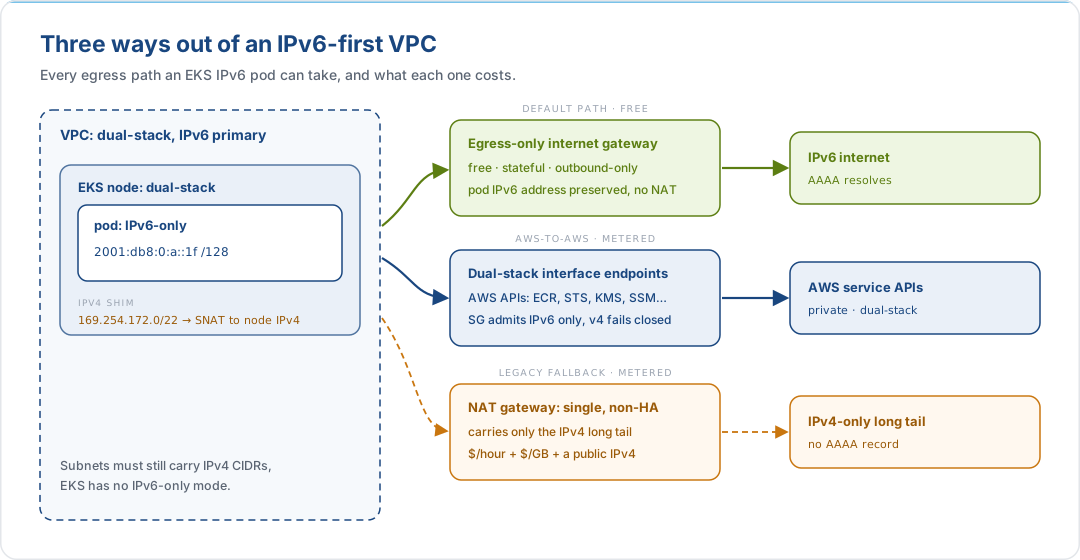
ipFamily: ipv6: pods and services get IPv6 only, via VPC CNI prefix delegation (a /80 per node, a /128 per pod). Every pod has a globally unique address from our own RIPE allocation. Node prefixes are taken from wherever is free in the subnet, so don't expect them to be contiguous. IP exhaustion maths, secondary CIDRs, and custom networking cease to exist as concepts. - Egress-only internet gateway as the default egress path: free, stateful, outbound-only, no per-GB processing charge, and the pod's own address is preserved (no SNAT).
- A single NAT gateway: not three, kept only as the legacy fallback for IPv4-only destinations.
- Dual-stack interface endpoints for the AWS APIs the cluster needs (ECR, STS, KMS, Secrets Manager, SSM), with a security group that admits only IPv6 on 443, so any client that resolves the A record fails closed.
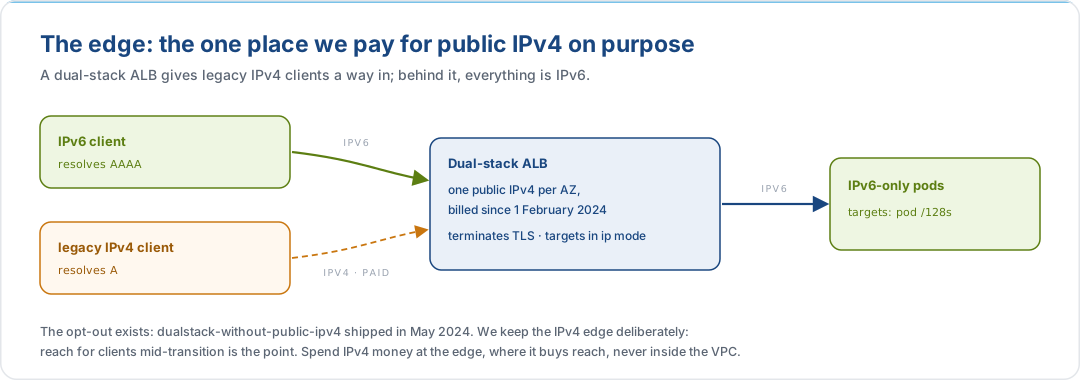
- Dual-stack ALBs at the edge, and CloudFront for static content.
- No RDS on the primary data path: the database tier is a managed service reached over PrivateLink. More on why below.
The gaps, dated
There is no such thing as an IPv6-only EKS cluster. ipFamily: ipv6 means pods and services are IPv6-only; the nodes remain dual-stack, and every subnet you give EKS must still carry an IPv4 CIDR. The choice is irreversible at cluster creation, Nitro instances only, no Windows pods, no Outposts, no FSx for Lustre, no custom networking. On top of that, the VPC CNI chains a host-local plugin that hands each pod a non-routable IPv4 address from 169.254.172.0/22 and SNATs it to the node's IPv4 when a pod talks to an IPv4-only destination. It is worth being precise about where that address lives, because the shape of it is easy to get wrong: eth0 inside the pod carries no IPv4 at all, and the shim sits on a second interface, v4if0. The range is the same 169.254.172.0/22 on every node rather than carved up between them, and each node allocates from it locally, so two pods on different nodes can hold the identical address. Nothing coordinates them because nothing has to. Those packets are rewritten at the node and never reach the wire. This interop shim is why IPv6 EKS "just works", and why you never fully escape IPv4: your v4-only dependencies don't crash, they just silently take the NAT path, and nothing in a stack trace will point at them.
RDS still cannot run without IPv4, anywhere. IPv6-only subnets are unsupported, and dual-stack mode requires an IPv4 CIDR on every subnet in the DB subnet group. Progress is real but slow: publicly accessible dual-stack databases shipped 31 October 2025, and IPv6 for VPC endpoints of the RDS service APIs only landed 30 January 2026. The common escape hatch is running the database tier off RDS entirely, using a managed datastore reached over PrivateLink (MongoDB Atlas is the canonical example) precisely because of this. Be clear-eyed about what that buys, though: PrivateLink interface endpoints themselves still require IPv4 today, so the hatch relocates the constraint to a different layer rather than deleting it. And we're not exempt: we still run an RDS instance for an internal tool, and that single instance is enough to pin IPv4 CIDRs onto its subnets regardless. The dependency only has to appear once.
ECR improved underneath us while we were running: dual-stack endpoints arrived 2 May 2025, PrivateLink support for them 21 November 2025. Before that, every image pull on an "IPv6" cluster was quietly riding the CNI's IPv4 shim. Dual-stack is still opt-in, mind: the default registry hostnames resolve to IPv4.
The default AWS endpoint hostnames are IPv4-only. Checked July 2026: sts.eu-west-1.amazonaws.com has no AAAA record; sts.eu-west-1.api.aws does. The SDKs default to the former, and AWS_USE_DUALSTACK_ENDPOINT is not on by default. If you don't opt in per client, or force the issue with dual-stack VPC endpoints as we do, your "IPv6" workload's AWS API calls are IPv4.
CloudFront can reach origins over IPv6, but not S3 or VPC origins: IPv6 origins shipped 8 September 2025 with both excluded. Our static sites are exactly that shape, so CloudFront speaks IPv6 to viewers and IPv4 to the S3 bucket behind it.
Internet-facing ALBs burn public IPv4 unless you opt out. A dual-stack ALB holds a public IPv4 per AZ, each billed since February 2024. dualstack-without-public-ipv4 has existed since May 2024 and eliminates the charge. We deliberately don't use it: our customers are, almost by definition, people mid-transition to IPv6. Our rule is to spend IPv4 money only at the edge, where it buys reach, never inside the VPC, where it buys nothing.
Then there's the long tail outside AWS. In July 2026 we looked up an AAAA record for every external service the platform calls, and several answer over IPv4 only. Each of those is a reason our single NAT gateway still exists, so make the same list for your own platform before you size anything.
What it saves
Reference setup: three AZs, HA, private nodes, one internet-facing ALB. The us-east-1 list prices, 730-hour month. Data transfer out is excluded, because it costs the same over both protocols. Pricing changes frequently; treat these as indicative and check the current VPC pricing.
| Monthly cost | Conventional IPv4/NAT | IPv6-first |
|---|---|---|
| NAT gateways (3 × $0.045/h) | $98.55 | $0 |
| NAT gateway EIPs (3 × $0.005/h) | $10.95 | $0 |
| NAT processing (~500 GB × $0.045) | $22.50 | $0 (egress-only IGW) |
| ALB public IPv4 (3 × $0.005/h) | $10.95 | $0 to $11 (your choice) |
| Total per environment | ≈ $143 | ≈ $0 to $11 |
The table needs one caveat: the ~$0 only holds if everything speaks IPv6. Every IPv4-only dependency puts you back on one of two meters. A kept NAT gateway is ~$36.50/month plus $0.045/GB even at low volume, though IPv6-first shrinks its blast radius: ours carries only the legacy long tail, so one non-HA gateway in one AZ is an acceptable risk instead of a three-AZ tax. Interface VPC endpoints are the other meter, at ~$7.30/AZ/month each plus $0.01/GB, and they multiply. Seven AWS-API endpoints across three AZs is ~$153/month, which comfortably rivals the NAT bill you were congratulating yourself for deleting. The saving is large but not automatic, and it improves every time AWS ships a dual-stack public endpoint you can reach through the egress-only IGW instead of paying for an interface endpoint.
Gotchas we hit
- The /28s didn't survive. We sized IPv4 subnets at /28 as a statement of intent. A /28 has 11 usable addresses after AWS reserves five, and dual-stack interface endpoint ENIs plus node primary ENIs ate them. We grew to /27 public and /26 private, grudgingly.
- Dual-stack endpoints resolve to both A and AAAA, and Happy Eyeballs clients will happily take the A. We enforce IPv6 at the security group, with v6-only ingress on 443, so IPv4 attempts fail closed instead of silently succeeding. (
ip_address_type = "ipv6"on an endpoint would be cleaner, but AWS only permits it on IPv6-only subnets, which EKS can't use.) ipFamilyis forever. Changing your mind means a new cluster and a workload migration.- Not every AWS API has caught up regionally: the
ec2messagesendpoint wouldn't accept an IPv6 address type in our region, so we run Session Manager onssm+ssmmessagesalone. - Your observability must speak IPv6 on day one, because the failure mode of everything above is silence, not errors. An AAAA lookup against every external dependency is how we found the ones quietly on the v4 path.
Verdict: worth it in 2026?
Yes, with a precise scope. If you are greenfield, Linux-on-Nitro, Kubernetes-native, and your datastore either supports IPv6 or hides behind PrivateLink anyway, IPv6-first EKS is the correct default in 2026. The constraint list is finite, documented above, and visibly shrinking: ECR, CloudFront origins, public RDS, and the RDS service APIs all moved between April 2025 and January 2026. You save ~$130+ per environment per month at small scale, more at NAT-heavy scale, and you permanently exit the IPv4 scarcity-management business: no more custom networking, secondary CIDRs, or overlapping RFC 1918 peering archaeology. We came for the missing NAT bill; we stayed because address planning stopped being a job.
If you need Windows pods, Outposts, an RDS-centred architecture, or your revenue path runs through IPv4-only SaaS APIs, do it with open eyes: you will be running that NAT gateway regardless, so run a minimal dual-stack VPC and take the interop wins without the purity. The protocol doesn't award style points. But check the list again in a year. Every one of these gaps has a shorter life expectancy than your cluster.
Sources
- AWS public IPv4 address charge (effective 1 February 2024)
- IPv6 addressing with Amazon RDS
- Amazon RDS IPv6 for publicly accessible databases (31 October 2025)
- Amazon RDS IPv6 for VPC endpoints of RDS service APIs (30 January 2026)
- EKS IPv6 cluster documentation and EKS IPv6 best practices
- Amazon ECR IPv6 support (2 May 2025) and ECR dual-stack PrivateLink (21 November 2025)
- Amazon CloudFront IPv6 origins (8 September 2025)
- ALB dual-stack without public IPv4 (May 2024)
- Egress-only internet gateways
- Amazon VPC pricing
This document is provided for informational purposes. Protocol specifications and cloud provider behaviour are subject to change. Consult the linked RFCs and vendor documentation for authoritative, up-to-date information before making architectural decisions.